


Summary:
If you live in New York City and you are dealing with back pain, you already know the math doesn’t work. Surgery means weeks off your feet, no subway, no commute, no keeping up with the pace of a city that genuinely does not slow down for anyone. Physical therapy alone hasn’t fixed it. Pain medication dulls the edge but doesn’t solve anything. And somewhere in the back of your mind, someone has probably said the word “surgery” (and you’re not ready for that conversation yet).
You’re not alone in that. And you may have more options than you’ve been told.
What Spinal Injections Do (And Why They Work)
A spinal injection isn’t a painkiller disguised as a procedure. When it’s done correctly (guided by live imaging, delivered to the exact anatomical source of your pain), it reduces the inflammation that’s compressing a nerve or irritating a joint. That’s the difference between masking a problem and truly interrupting it.
The relief that follows creates a real window. A window where your body can begin healing, where physical therapy can take hold, and where the cycle of chronic pain gets a genuine chance to break. For many patients, that window turns into lasting relief. The research backs this up: long-term outcomes for spinal injections are comparable to surgery for many conditions (without the incisions, the anesthesia, or the recovery timeline that makes surgery so disruptive for anyone living a full life in New York City).
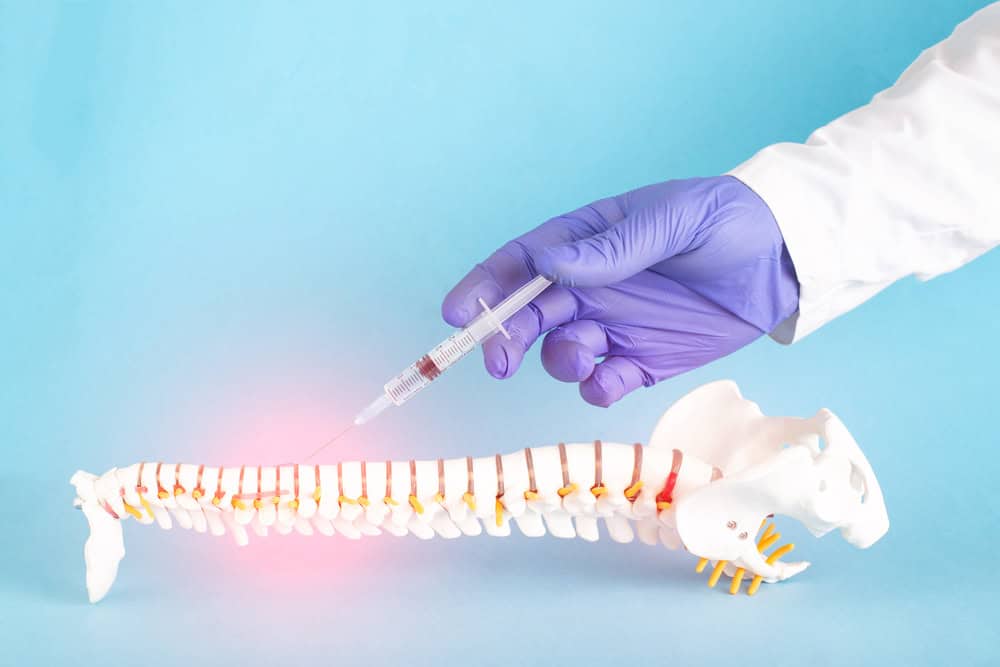
What Types Of Spinal Injections Are Used For Back And Neck Pain?
The term “spinal injection” covers more ground than most people realize. The right type depends entirely on where your pain is coming from and what’s causing it (which is precisely why diagnosis matters as much as the procedure itself).
Epidural steroid injections are among the most common. They deliver anti-inflammatory medication into the epidural space around the spinal cord, targeting the nerve roots that are being compressed or irritated. There are three main approaches (transforaminal, interlaminar, and caudal), and the research consistently shows that the transforaminal approach tends to be the most precise, achieving equivalent or better results with a lower dose of corticosteroids. For lumbar disc herniation specifically, the evidence supporting transforaminal epidural injections is rated as strong.
Facet joint injections address a different source of pain entirely. The facet joints connect the vertebrae and allow your spine to move, but they’re also one of the most commonly overlooked contributors to chronic neck and back pain (implicated in up to 70% of chronic cervical spine pain cases and up to 30% of lumbar cases). When those joints become inflamed or arthritic, the pain can radiate in ways that feel a lot like disc-related pain, which is part of why accurate diagnosis is so critical before any injection is performed.
Sacroiliac joint injections, nerve blocks, and radiofrequency lesioning round out the toolkit for patients whose pain originates in different structures. The point isn’t that one type is better than another. It is that the right injection, placed in the right location by a physician who genuinely understands spinal anatomy, is a fundamentally different experience than a generalized approach.
Do Spinal Injections Last, Or Is The Relief Temporary?
This is the question we hear most often, and it deserves a straight answer rather than a vague reassurance.
The honest answer is that it depends on the diagnosis, the precision of the injection, and what you do during the relief window. An injection delivered to the wrong location (or to the right location but without imaging guidance) won’t perform the way a properly targeted one will. This is why fluoroscopy matters. Fluoroscopy is a form of live X-ray imaging that allows our physician to watch the needle in real time and confirm placement before medication is delivered. It’s the difference between precision and approximation, and it has a direct effect on outcomes.
When the injection is accurate and the underlying condition is appropriate for this type of treatment, many patients experience relief that extends well beyond the steroid’s active period. The inflammation subsides, the nerve decompresses, and the body’s own healing processes take over. Paired with a structured rehabilitation plan, that relief can hold for months (and in many cases, longer).
Recurrence is often tied to the same lifestyle factors that caused the problem: prolonged sitting, poor posture, physical stress without proper support. Treating the injection as one part of a broader plan (not a standalone cure) is what produces the most durable results. Up to three lumbar epidural steroid injections per year can be administered when clinically appropriate, managed carefully based on how you respond.
Want live answers?
Connect with a NY Spine Medicine expert for fast, friendly support.
Why This Matters More If You Live In New York City
Back pain anywhere is hard. Back pain in New York City is its own category of problem.
The average New Yorker walks three to five miles a day on concrete and asphalt (surfaces that provide zero shock absorption and send every step straight up the spine). Subway commutes mean standing in jolting cars, carrying bags on one shoulder, navigating stairs in stations that haven’t been updated in decades. Manhattan office workers spend hours at desks in open-plan spaces that weren’t designed with ergonomics in mind. And when winter hits in the Bronx, on Staten Island, in Brooklyn, across Queens, icy sidewalks turn routine walks into acute injury risks.
The city creates spinal stress in ways that most treatment protocols weren’t designed around. This is also why the recovery demands of traditional back surgery are particularly disruptive here.

Why NYC Patients Can't Always Afford Weeks Of Surgical Recovery
Back surgery (even when it goes well) typically requires four to six weeks of significantly limited mobility. For someone commuting from Queens or Staten Island, that means no subway, no driving, no carrying groceries, no functioning at full capacity at work. For a professional in Midtown, it means weeks away from the office or struggling through a recovery that isn’t compatible with the pace of the job. For a parent in Brooklyn or the Bronx juggling work, kids, and everything else, six weeks of restricted movement isn’t a minor inconvenience. It’s a genuine crisis.
Spinal injections operate on a completely different timeline. The procedure itself is outpatient. Afterward, you’re monitored for about 15 to 20 minutes to make sure there are no adverse reactions, and then you go home. Most people return to their normal daily activities within a day or two. That’s not a minor logistical advantage. For New Yorkers, it’s often the deciding factor.
There’s also the question of what surgery involves beyond the recovery. General anesthesia. An incision. Permanent changes to spinal anatomy. A hospital stay. Risks that come with any invasive procedure. None of those elements are present in a properly performed spinal injection. The minimally invasive nature of the procedure isn’t just a talking point. It is a meaningful clinical distinction that affects everything from risk profile to return-to-life timeline.
For patients who have been told surgery is the next step, it’s worth asking if every non-surgical option has truly been exhausted. Research published in peer-reviewed medical journals found that the long-term outcomes of spinal injections are comparable to surgery for many conditions, a finding that should factor into any serious conversation about next steps.
How To Know If You're Seeing The Right Spinal Injection Specialist In NYC
New York City has no shortage of pain management practices. What it has less of is physicians with the specific combination of training and certification that makes spinal injections genuinely safe and effective (rather than just available).
Board certification in interventional pain management is the baseline. It means the physician has completed advanced fellowship training specifically in these procedures and has been evaluated against a national standard. But there’s a layer above that: double board certification in both interventional pain management and neurology. That combination is held by approximately 200 physicians in the entire country. It matters because the neurological piece (understanding how the nervous system processes and perpetuates pain) changes how a physician diagnoses, targets, and manages complex spinal pain cases.
Our physician completed his interventional pain management fellowship at Columbia University/NewYork-Presbyterian Hospital (consistently ranked among the top five hospitals in the nation) and his neurology training at Emory University. He currently holds an academic appointment as an assistant professor of anesthesiology and neurosurgery at Cornell University, the top-rated hospital system in the New York region. For ten consecutive years, he has been named to the Castle Connolly and New York Magazine Best Doctors list.
That level of training isn’t something you’ll find at most practices across Manhattan, Brooklyn, Queens, the Bronx, or Staten Island. When the procedure involves your spine, the credentials behind the physician performing it are not a secondary consideration.
We also offer a complimentary MRI review for patients who already have imaging. If you’ve had an MRI done and you’re not sure what your options are, you can send it to us and one of our physicians will review it with no commitment required. It’s a straightforward way to get an expert perspective before making any decisions about your care.
Is A Spinal Injection The Right Next Step For Your Back Pain?
Not every back pain patient needs a spinal injection. But far more patients are good candidates than realize it, and far too many are heading toward surgery without fully exploring what a precisely targeted, imaging-guided injection from a specialized physician could do for them first.
If you’ve been living with pain that hasn’t responded to conservative treatment, if surgery has been mentioned and you’re not ready for that conversation, or if you’re tired of managing symptoms without addressing the source, it’s worth having a real conversation about what is driving your pain and what can be done about it without putting your life on hold.
NY Spine Medicine is located in Midtown Manhattan, accessible from all five boroughs. Reach out to schedule a consultation or take advantage of our complimentary MRI review to find out what your options look like.