

Summary:
The reason an EMG feels intimidating is not really the needles. It is that most people walk in with no idea of the order things happen in, and uncertainty makes everything feel longer than it is.
So here is the plain sequence. You will be brought into a warm room and asked to expose the arm or leg being tested. Electrodes go on with tape. A machine delivers brief electrical pulses. Then, if it is indicated, a very thin needle electrode is placed in a few muscles while you relax and then gently contract them. Then you get dressed and go home. Most appointments run somewhere between thirty and sixty minutes.
The rest of this is the detail inside that outline, told in the order you will actually experience it.
The Shape Of The Appointment, From Check In To Walking Out
The visit has four stages, and they always run in the same order.
First, a short conversation. Someone will ask where your symptoms are, when they started, what makes them worse, and whether you have a pacemaker, a spinal cord stimulator, a blood thinner, or swelling in an arm after lymph node surgery. Those questions change how the study is done, so they are worth answering carefully even if you have answered them twice already.
Second, the nerve conduction study. Surface electrodes only, no needles, and this portion often takes the largest share of the appointment.
Third, the needle examination, if it is needed. Not every patient requires it, and the physician decides based on what the conduction study showed.
Fourth, a brief wrap up. You are usually told the general direction of the findings before you leave, with the formal report going to whoever ordered the test.
What Happens In The First Few Minutes On The Table?
You will be asked to remove clothing over the area being tested and to lie down or sit in a reclining chair. Jewelry on that limb comes off. If you are wearing lotion, the skin gets cleaned, because lotion interferes with electrode contact.
The first thing that surprises people is the temperature. The room will be warm, and if your hands or feet are cold, they will be warmed with a heating pad or warm water before anything starts. This is not hospitality. Cold limbs conduct more slowly, and a cold hand can produce a result that looks abnormal when the nerve is perfectly fine. Warming is part of the accuracy of the test.
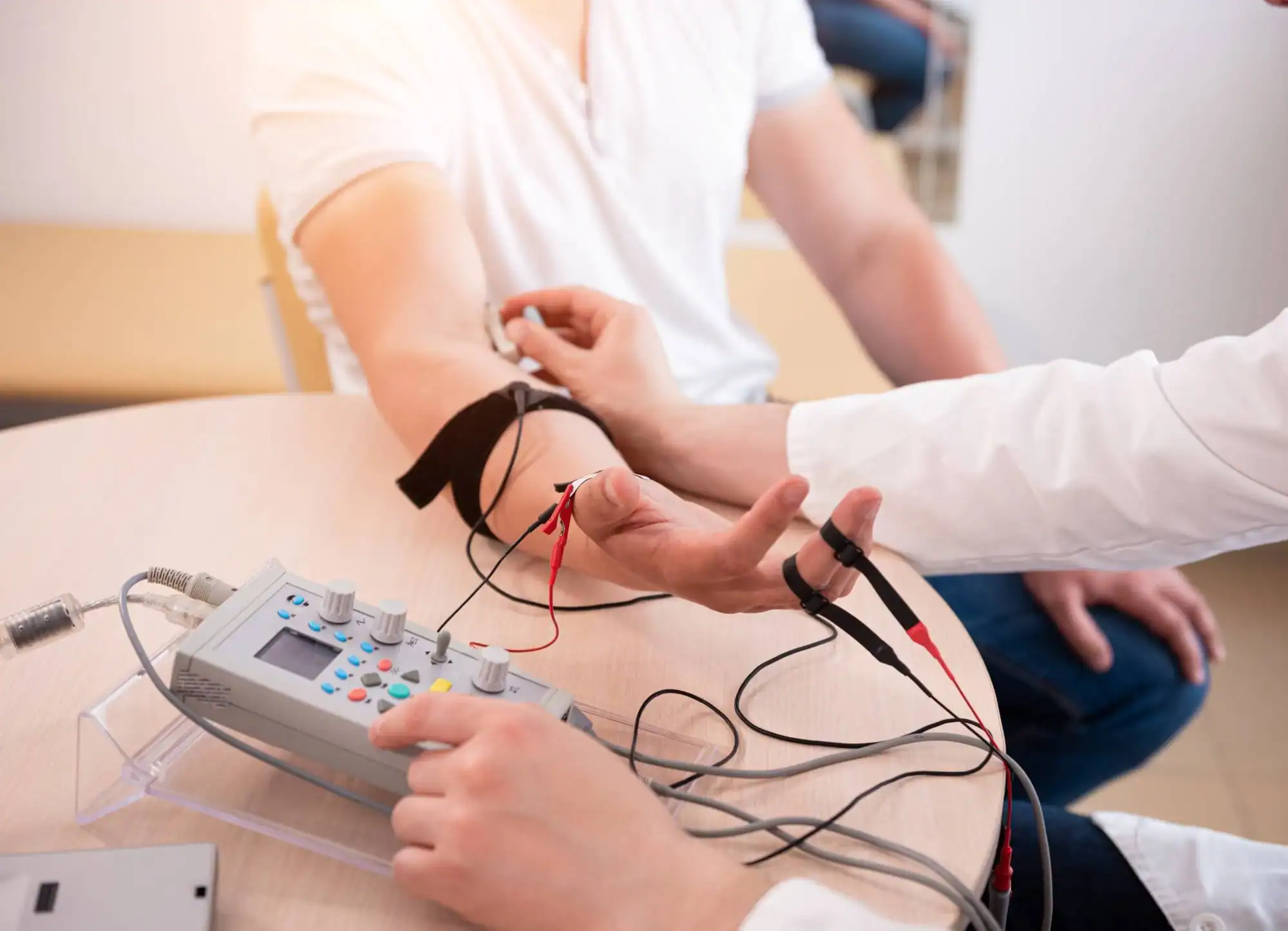
Next come the electrodes. Small flat discs are taped onto the skin, usually over a muscle in the hand or the foot, with another placed nearby as a reference and a ground strap wrapped around the limb. A conductive gel may be used. None of it is uncomfortable and none of it breaks the skin.
The technologist will then measure distances along your limb with a tape measure and mark your skin with a washable pen. Those measurements are part of the calculation, since speed depends on knowing exactly how far the signal traveled.
Then comes the first stimulus, which is the moment most people are bracing for. It is a very brief electrical pulse, felt as a sharp tap or a snapping sensation, and your fingers or toes may twitch on their own. It is startling the first time and unremarkable by the fifth. Each pulse lasts a small fraction of a second, and there is a pause between them.
You do not have to do anything during this portion. Your only job is to stay as relaxed as you can, because tense muscles add electrical noise to the recording.
Step By Step Through The Nerve Conduction Portion Of The Test
This part is repetitive by design, and understanding the repetition makes it easier to sit through.
Each nerve is tested more than once. The technologist stimulates at one point, records the response, then moves to a second point further along the same nerve and repeats it. Sometimes there is a third and a fourth. That is how the study measures a segment rather than a single spot, and it is why comparing results between points matters more than any single reading.
Motor nerves and sensory nerves are tested separately, and they feel slightly different. Motor testing produces a visible twitch in the muscle, which is normal and entirely outside your control. Sensory testing usually uses lower intensity, and the sensation is a smaller tap without much movement.
The intensity is adjusted as the study runs. The technologist starts low and increases the current until the response stops getting bigger, which is how they know every fiber in the nerve is responding. That means a few of the pulses will be stronger than the earlier ones. You can say so if it is too much, and the pace can be adjusted.
Both sides are often tested even when only one side has symptoms. Your unaffected limb is the best possible comparison, so this is a sign of a thorough study rather than of a problem found.
Expect this portion to take fifteen to forty minutes depending on how many nerves are involved. A single suspected carpal tunnel is quick. A generalized neuropathy affecting both legs takes considerably longer, because more nerves are on the list.
Want live answers?
Connect with a NY Spine Medicine expert for fast, friendly support.
How Long Each Part Takes And Why The Time Varies
There is no fixed length, and any office that quotes you an exact number is guessing.
Simple single nerve studies, of the kind ordered for suspected carpal tunnel syndrome, often run about thirty minutes including the needle portion. Studies covering an entire limb, or both legs, more commonly run forty five minutes to an hour.
The reason is that the study is built as it goes. If the first several nerves are normal, the physician may narrow the search. If an unexpected finding appears, additional nerves get added to work out how widespread it is. That flexibility is what makes the test useful, and it is also why the schedule is approximate.
Plan for the appointment to run longer than you were told, and avoid scheduling anything tight afterward. You can drive yourself home, since nothing given during the test affects your ability to do that.

The Needle Portion, Sensation By Sensation, Without Sugarcoating
The needle used is not the kind used to draw blood. It is a fine solid wire electrode, thinner than an injection needle, and nothing is injected through it. It records, and that is all it does.
The sequence in each muscle is the same, and it takes under a minute. The skin is cleaned. The electrode goes in. You are asked to stay completely relaxed while the machine listens to the muscle at rest. Then you are asked to contract that muscle gently, often against light resistance, and hold it briefly. Then the electrode comes out and the physician moves to the next muscle.
The sensations, in order: a quick sting as the electrode passes through the skin, which is the sharpest moment and is over in a second. A deeper pressure or a cramping ache while it sits in the muscle. A short burst of discomfort each time the electrode is repositioned slightly, which happens a few times in each muscle because several spots are sampled. And a mild ache afterward that fades within a day.
Some muscles are more sensitive than others, and not always the ones you would predict. The small muscles of the hand and foot and the muscles running alongside the spine tend to be more uncomfortable. Larger muscles in the arm and thigh are usually easier.
Typically five to eight muscles are examined, sometimes fewer, and the whole portion often takes ten to twenty minutes. Nothing about it requires sedation, and numbing the skin is generally avoided because it can interfere with the recording.
You are allowed to ask for a pause. Saying that you need a moment does not ruin the study, and being tense actually makes the resting recording harder to read, so a short break sometimes helps the data as much as it helps you.
Why You Are Asked To Tense And Then Completely Relax A Muscle
The instructions during the needle portion sound arbitrary. They are not, and following them precisely is the single biggest thing you can do to make the test accurate.
The resting recording comes first. A healthy muscle at rest is electrically silent, so any activity that appears there is meaningful. That is why you are asked to go completely limp, and why the physician may wait and adjust the electrode until the muscle truly settles. If you are guarding the limb, holding it up, or bracing against expected discomfort, the muscle is not at rest and the recording cannot be interpreted properly.
Then comes the gentle contraction. At light effort, only a few motor units are active, and the machine can isolate their individual shapes. This is where the differences between muscle disease and nerve disease appear, in the size and duration of those units. If you contract too hard at this stage, dozens of units fire at once, the signals overlap, and nothing useful can be measured.
Finally you may be asked for a stronger effort. That tests recruitment, which is how a muscle brings additional units online as demand increases. A muscle that has lost nerve supply recruits sparsely with rapid firing. A diseased muscle recruits many units for very little force. That contrast is one of the most informative parts of the entire examination.
The other thing the physician is doing is listening. The machine converts electrical activity into sound through a speaker, and abnormal patterns have distinctive audible signatures. If you hear crackling or popping from the speaker, that is normal equipment behavior rather than an alarm.
The practical version: relax when you are told to relax, push gently when you are told to push gently, and let the limb be moved rather than helping. Anticipating the next instruction is the most common way patients unintentionally make the study harder.
Walking Into Your Appointment Knowing What Comes Next
The real takeaway is that an EMG is uncomfortable in short bursts and not much else. There is no sedation, no recovery period, and nothing to arrange afterward. Most people describe it as far less of an ordeal than the version they had built up beforehand.
A more useful reframe: the parts that feel odd, the warming, the repeated stimulation, the request to relax completely, are all there for accuracy. This test is unusual among diagnostics in that how you participate genuinely affects the quality of the answer.
At NY Spine Medicine, EMG and nerve conduction testing is performed at our Manhattan and Brooklyn offices by physicians who explain each step as they go rather than working in silence. If a portion of the study is not needed, we do not do it, and if you need to slow down, we slow down.
If you have testing coming up, or a doctor has recommended it and you have been putting it off, call us at 212-750-1155 and we will walk you through exactly what your study would involve.