

Summary:
If you’ve been dealing with back pain for months — or years — and physical therapy hasn’t delivered the relief you expected, you’re not alone. A lot of people cycle through PT, rest, medication, and back again without ever feeling like they’ve actually turned a corner. The frustrating part is that physical therapy, done right, genuinely works. The problem is usually not the modality. It’s that the program wasn’t built around what’s actually wrong with your spine. This post explains what effective spine rehabilitation looks like, what it’s designed to accomplish, and how the right approach — one that starts with an accurate diagnosis — can get you back to functioning the way you’re supposed to.
What Physical Therapy for Spine Pain Is Actually Designed to Do
Physical therapy for spine pain isn’t about doing the same ten exercises every session until something improves. At its core, it’s a structured process of rebuilding the physical foundations your spine depends on — strength, flexibility, mobility, and posture — in a sequence that matches where you are in your recovery.
The goal isn’t just pain reduction, though that matters. The goal is restoring function. Being able to sit through a workday, commute without bracing yourself, pick something up off the floor, or get back to the gym without triggering a flare-up. Pain is a signal that something is wrong structurally or mechanically. Physical therapy addresses the underlying mechanics, not just the signal.
When a program is built correctly — with a clear picture of your diagnosis, your movement patterns, and your daily demands — it becomes a roadmap, not a guessing game.
Why Generic PT Programs Often Fall Short for Spine Injuries
Physical therapy fails patients far more often because of how it’s delivered than because of what it is. A large percentage of people who say “PT didn’t work for me” went through a program where the exercises were chosen based on a general back pain diagnosis, not their specific spinal condition. That’s a meaningful distinction.
A herniated disc at L4-L5 behaves differently from degenerative disc disease at the same level. Sciatica caused by nerve compression responds differently than sciatica caused by piriformis irritation. If the program doesn’t account for those differences — if it’s the same sequence of stretches and core exercises given to every back pain patient who walks in — the results will be inconsistent at best.
This is why physician oversight changes the equation. When a physical therapy program is designed by or in close collaboration with a pain specialist who has reviewed your imaging and understands your neurological picture, the exercises you’re doing are chosen because of what’s actually happening in your spine. That’s not a small thing. It’s the difference between targeted rehabilitation and educated guessing.
A well-run PT program doesn’t stay static. It advances as you improve, challenges you appropriately, and adjusts when something isn’t working. High-volume clinics — where you might see a different therapist each visit and spend most of your session on a table with a heat pack — rarely have the bandwidth to do that well. The result is patients who plateau quickly and conclude that PT simply doesn’t work for them.
Many people with spine injuries are genuinely afraid to exercise. They’ve been told to rest, or they’ve had a flare-up after trying to stay active, and now movement itself feels like a threat. That fear — clinically called kinesiophobia — is well-documented as a driver of worsening pain and disability over time. A good PT program addresses it directly, helping patients understand what’s safe, what’s beneficial, and why staying active is almost always better than staying still.
What a Personalized Spine Rehabilitation Program Actually Includes
When we talk about personalized physical therapy for spine pain, we mean something specific. It starts before the first exercise is prescribed. It starts with a clear diagnostic picture — imaging that shows exactly which structure is involved, at what level, and to what degree. That information shapes everything that follows.
From there, a comprehensive spine rehabilitation program typically works across four dimensions. Strength training targets the muscles that support the spine — the deep core stabilizers, the paraspinal muscles, the hip complex — because structural weakness is one of the primary reasons spine pain becomes chronic. When those muscles aren’t doing their job, the spine absorbs forces it shouldn’t have to.
Flexibility work restores range of motion that’s been lost to guarding, scar tissue, or prolonged immobility. This isn’t passive stretching for its own sake — it’s targeted work to restore the specific movements your spine needs to function normally.
Mobility training is related but distinct. Where flexibility is about tissue length, mobility is about how well your joints and segments actually move through their full range under load. Spine patients often have segments that are either hypermobile (moving too much, compensating for a stiff area) or hypomobile (locked down and not moving at all). Addressing those imbalances is central to real rehabilitation.
Posture therapy rounds out the picture. For professionals working in New York City’s offices, it’s often where the most immediate gains are made. Spending eight to ten hours a day at a desk, carrying a laptop bag on one shoulder, and riding the subway in positions that load the spine asymmetrically — these are the daily habits that created the problem in the first place. A PT program that doesn’t address them is treating the injury without addressing its source.
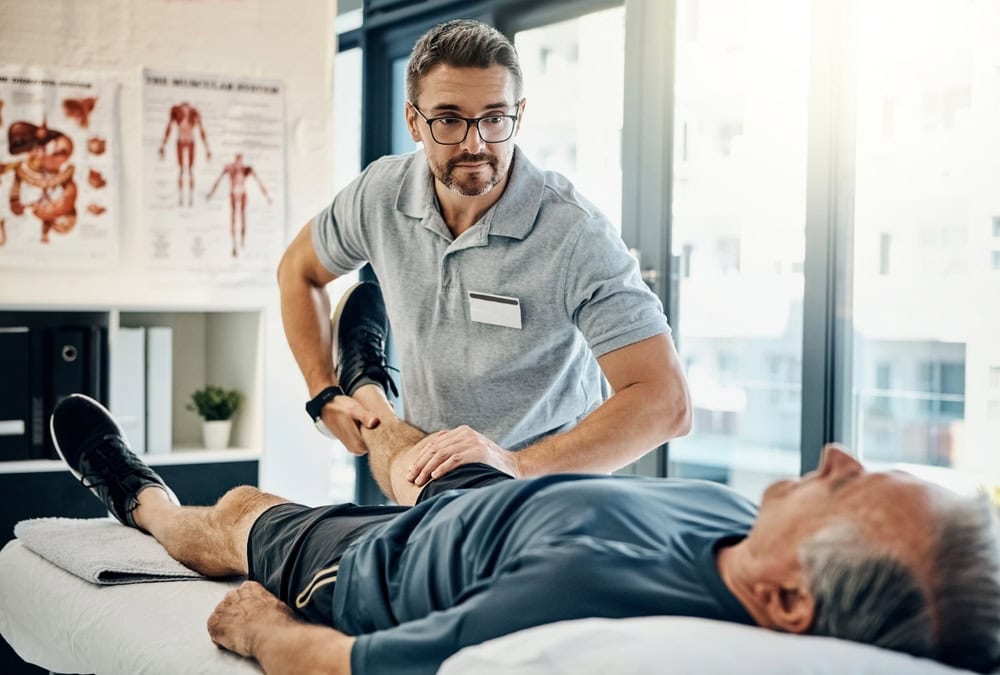
Manual therapy — hands-on joint mobilization and soft tissue work — is often woven throughout, particularly in the early stages when pain and stiffness are limiting what active exercise can accomplish. It’s not a substitute for active rehabilitation, but it’s a valuable tool for reducing pain and restoring mobility quickly enough that the active work can begin.
Want live answers?
Connect with a NY Spine Medicine expert for fast, friendly support.
Physical Therapy as Part of an Integrated Spine Treatment Plan
One of the most common gaps in spine care is the disconnect between the physician managing a patient’s pain and the physical therapist working with them three times a week. When those two things happen in separate locations, with separate records and no real communication, the patient ends up carrying the coordination burden themselves.
The integrated model — where physical therapy is part of a broader treatment plan overseen by the same physician who diagnosed you, reviewed your imaging, and understands your full clinical picture — produces different outcomes. Not because the exercises are magic, but because every component of your care is working toward the same goal, informed by the same information.

How Physical Therapy Fits Into a Non-Surgical Pain Management Approach
Surgery should be a last resort for spine pain. The evidence consistently shows that for the vast majority of spine conditions, conservative treatment that includes physical therapy, targeted interventional procedures when needed, and patient education produces outcomes that are comparable to surgery, with far less risk and recovery time.
Physical therapy is often the right first step. For many patients, a well-designed PT program — one that builds strength, restores mobility, and addresses the postural and movement habits driving the pain — is enough to achieve lasting relief without any additional intervention.
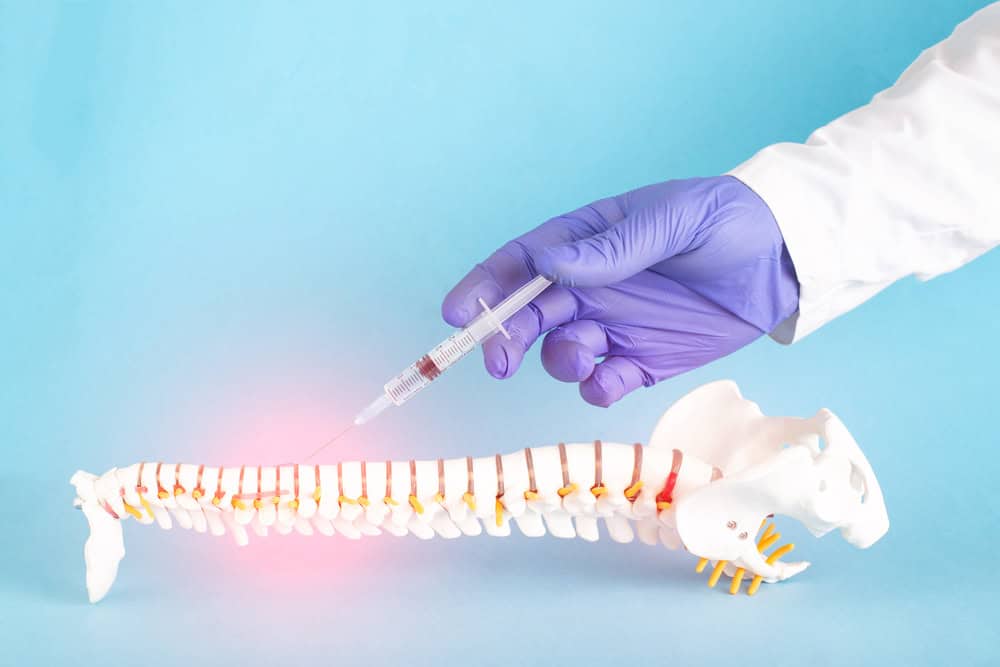
But for some patients, there’s a structural problem that PT alone can’t fully address. A nerve that’s significantly compressed. A facet joint that’s inflamed beyond what exercise can resolve. A disc that’s causing enough chemical irritation that the surrounding muscles can’t relax enough to respond to therapy. In those cases, a targeted injection — an epidural, a nerve block, a joint injection — can reduce the pain and inflammation to a level where physical therapy becomes effective again.
This is the advantage of receiving PT within a practice that also offers interventional pain management. The question is never “PT or injections” — it’s “what does this patient need right now, and in what sequence?” Sometimes PT comes first. Sometimes a procedure creates the window that makes PT possible. The ability to move fluidly between those options, without sending a patient to a different practice and starting over from scratch, is what makes integrated care meaningfully different.
For patients recovering from an injection or a minimally invasive procedure, physical therapy is often what consolidates the gains. The procedure reduces pain. The PT builds the strength and movement patterns that keep it from coming back. Neither is as effective without the other.
Physical Therapy for Spine Pain in NYC: What Makes This City's Patients Different
Spine pain is universal, but the way it develops and what sustains it is shaped by how you live. And life in New York City puts a specific set of demands on your spine that most physical therapy content doesn’t acknowledge.
Consider the average Manhattan professional’s day. They commute via subway — standing on a platform, bracing during sudden stops, carrying a bag that loads one shoulder more than the other. They sit at a desk for the better part of eight hours, often with a screen positioned in a way that pulls the head forward and rounds the upper back. They walk on uneven pavement, navigate crowded sidewalks, and do it all again the next day. That’s a chronic, repetitive pattern of spinal loading that doesn’t resolve on its own.
We’re located at 18 E 48th Street in Midtown Manhattan, steps from Grand Central Terminal. The patients we see every day are commuters, professionals, and active New Yorkers — people who can’t afford to be sidelined and need a treatment plan that fits into a real life, not an idealized one. That context shapes how we build physical therapy programs. We’re not designing recovery plans for someone who can rest for three months. We’re designing them for someone who needs to be functional this week.
A significant number of patients who come to us have already done PT at another clinic — sometimes multiple clinics — without lasting results. For those patients, the starting point isn’t the exercises. It’s understanding why the previous approach didn’t work, which requires the kind of diagnostic depth that a standalone PT clinic isn’t equipped to provide. When a double-board-certified pain specialist reviews your imaging and your history before a single exercise is prescribed, the program that follows is built on a fundamentally different foundation.
New York City winters add another layer. Slip-and-fall injuries from icy sidewalks and subway entrances spike every December through February, creating a wave of acute spine and hip injuries that require careful, progressive rehabilitation to resolve fully. And post-pandemic return-to-office patterns have introduced a new cohort of patients — people who spent years working from home in ergonomically poor setups and are now dealing with the accumulated consequences of that.
The point isn’t that NYC spine pain is uniquely exotic. It’s that the conditions driving it here are specific, and a PT program worth following should reflect that specificity.
Finding the Right Physical Therapy Program for Spine Pain in NYC
If physical therapy hasn’t worked for you before, the answer probably isn’t to give up on it. It’s to find a program that’s actually built around your diagnosis — one that starts with a clear picture of what’s wrong, addresses strength, flexibility, mobility, and posture in a sequence that makes sense for your condition, and adjusts as you improve.
The difference between PT that works and PT that doesn’t is rarely the exercises themselves. It’s the diagnostic foundation underneath them, the physician oversight guiding them, and the integration with other treatment options when they’re needed.
If you’re dealing with back pain, a spine injury, or chronic pain that hasn’t responded to treatment, we’d encourage you to reach out to NY Spine Medicine. A real conversation about what’s actually happening — and what a comprehensive, personalized plan could look like for you — is a reasonable next step.