

Summary:
Most people do not go to a doctor because their toes tingle. They go months later, when the tingling has reached the middle of the foot, or when they have tripped twice on a curb they saw clearly.
Neuropathy is patient. It progresses slowly, and slow change is easy to normalize. Patients tell us they assumed it was age, or circulation, or the shoes.
The reason to be evaluated early is straightforward. The underlying cause is often treatable, and treating it early protects the nerve that has not been damaged yet. Here are the five signs worth acting on.
Sign One: Numbness Or Tingling That Keeps Spreading
The earliest symptom of the most common neuropathies is a pins and needles sensation in both feet, starting in the toes. What matters is not the sensation itself but whether it is moving. If numbness that used to involve your toes now includes the ball of the foot, and a year later the ankle, that pattern of upward progression is the signature of a length dependent neuropathy, and it is a reason to be evaluated now rather than at your next annual physical.
Symmetry is a clue too. Both feet, affected roughly equally, points toward a systemic cause such as diabetes, prediabetes, a vitamin deficiency, thyroid disease, alcohol use, or a medication side effect. Symptoms in one foot only, or in a pattern that follows a single nerve or a stripe down the leg, points somewhere else entirely, often to the spine or to a compressed nerve, and that workup is different. Hands developing symptoms after the feet, which typically happens once numbness has reached the knees, is a later stage finding worth reporting promptly.

Sign Two: Why Is The Burning Pain Worse At Night?
Nerve pain has a distinctive quality. Patients describe burning, electric shocks, deep aching, stabbing, or the sensation of walking on gravel or hot sand. Some describe feet that feel cold to them but are warm to the touch. Others report the opposite of pain, a feeling that the foot is wrapped in a thick sock or a layer of cardboard that never comes off. Allodynia, in which the weight of a bedsheet becomes painful, is a classic symptom that patients rarely think to mention.
The nighttime pattern is the tell. Nerve pain that is quiet during the day and severe at night, disrupting sleep several nights a week, is a common presentation and one of the more reliable ways to separate neuropathic pain from mechanical pain. Part of it is that daytime activity and sensory input distract from the signal. Part of it is that damaged nerves fire spontaneously, without ordinary input to compete with. Keep a rough note of how many nights a week it wakes you, because that number is one of the more useful things you can bring to an appointment.
This one matters because sleep loss compounds everything. Pain tolerance drops, mood drops, and blood sugar control becomes harder in patients with diabetes, which in turn worsens the neuropathy itself. There are effective approaches to neuropathic pain, including specific medication classes, topical treatments, and in selected difficult cases spinal cord stimulation, but none of them substitute for identifying the cause. If your feet burn at night, get evaluated rather than waiting to see whether it settles. Persistent nighttime nerve pain rarely settles on its own.
Sign Three: Your Balance Has Changed, Especially In The Dark
Sensory nerves do more than register pain and touch. They tell your brain where your feet are in space, and that information is a large part of how you stay upright. The medical term is proprioception, and losing it is a quieter problem than pain but often a more dangerous one. When those fibers are damaged, balance degrades, and patients usually notice it in specific situations before they notice it in general.
The classic ones are worth recognizing. Feeling unsteady in the shower with your eyes closed. Reaching for a wall in a dark hallway. Difficulty walking on grass, gravel, sand, or any uneven surface. Needing to watch your feet on stairs. Widening your stance without deciding to. Patients often describe the floor feeling unfamiliar, as though it belongs to someone else. Vision compensates for lost sensation, which is exactly why the problem shows up when the lights go out.
Do not file this under getting older. Falls are the part of neuropathy that changes lives, and a hip or wrist fracture in an older adult carries consequences well beyond the fracture itself. Balance loss is also one of the more actionable findings, because gait and balance training genuinely helps, home hazards can be fixed, and other contributors such as vision changes, inner ear problems, blood pressure medication, and vitamin B12 deficiency are all identifiable. If you have already fallen once, or caught yourself on furniture more than a few times in recent months, that is a reason to be seen soon rather than eventually.
Want live answers?
Connect with a NY Spine Medicine expert for fast, friendly support.
Sign Four: Weakness You Have Been Explaining Away
Sensory symptoms usually come first, but when motor nerves become involved the picture changes and the urgency rises. Watch for catching your toe on curbs and rugs, a foot that slaps the floor as you walk, difficulty with buttons, keys, or jar lids, dropping things you thought you had hold of, and visible thinning of the muscles in the hands or between the toes.
Weakness that develops over days rather than months is a different situation and needs urgent evaluation, not an appointment next month. The same is true for weakness that climbs quickly up the legs, involves the face or breathing, or arrives alongside loss of bowel or bladder control. Those patterns can indicate conditions that are far more treatable when they are caught early.
Sign Five: Injuries And Skin Changes You Never Felt Happen
This is the sign patients dismiss most often and the one clinicians take most seriously. If you find a blister, a cut, a callus that has broken down, or a burn on your foot and cannot say when it happened, protective sensation is already reduced. That is not an early symptom. That is a foot at risk. Patients frequently discover it only because somebody else pointed it out.
The mechanics are simple and unforgiving. Pain is what makes you shift position, take off the shoe, or step away from the heat. Without it, a small pressure point becomes an ulcer, and an ulcer in a foot with reduced sensation and reduced circulation can turn into a serious infection quickly. Related changes deserve the same attention: skin that has become thin, shiny, or unusually dry, nails that thicken or change shape, hair loss on the toes and lower legs, swelling, or a change in the shape of the arch. None of these prove anything on their own, but together they describe a limb that is not getting what it needs.
If you have diabetes, this sign should trigger a visit rather than a plan to watch it. Check your feet daily, including between the toes and along the sole, using a mirror if you cannot see the bottom easily. Never test bath water with your foot, avoid heating pads on the feet, do not walk barefoot even indoors, and have your shoes fitted properly. Any open wound, redness with warmth, drainage, or new odor needs to be seen promptly rather than watched over a weekend. Foot care in the setting of neuropathy is not a minor addition to treatment. It is the part that prevents the outcomes everyone is trying to avoid.
What A Neuropathy Evaluation Involves And Why The Cause Matters
The point of seeing a physician about neuropathy is not to be handed a prescription for burning feet. It is to find out why the nerves are being damaged, because a meaningful proportion of causes are treatable, and treating the cause is what slows or halts progression.
A proper evaluation starts with your history and a focused neurological exam, testing sensation to light touch, vibration, temperature, and pinprick, checking reflexes, and assessing strength and gait. Blood work is standard and typically screens for diabetes and prediabetes, vitamin B12 and other deficiencies, thyroid function, kidney function, and inflammatory or immune markers depending on the picture. A medication review matters more than patients expect, since several common drug classes, including some chemotherapy agents, can cause neuropathy.
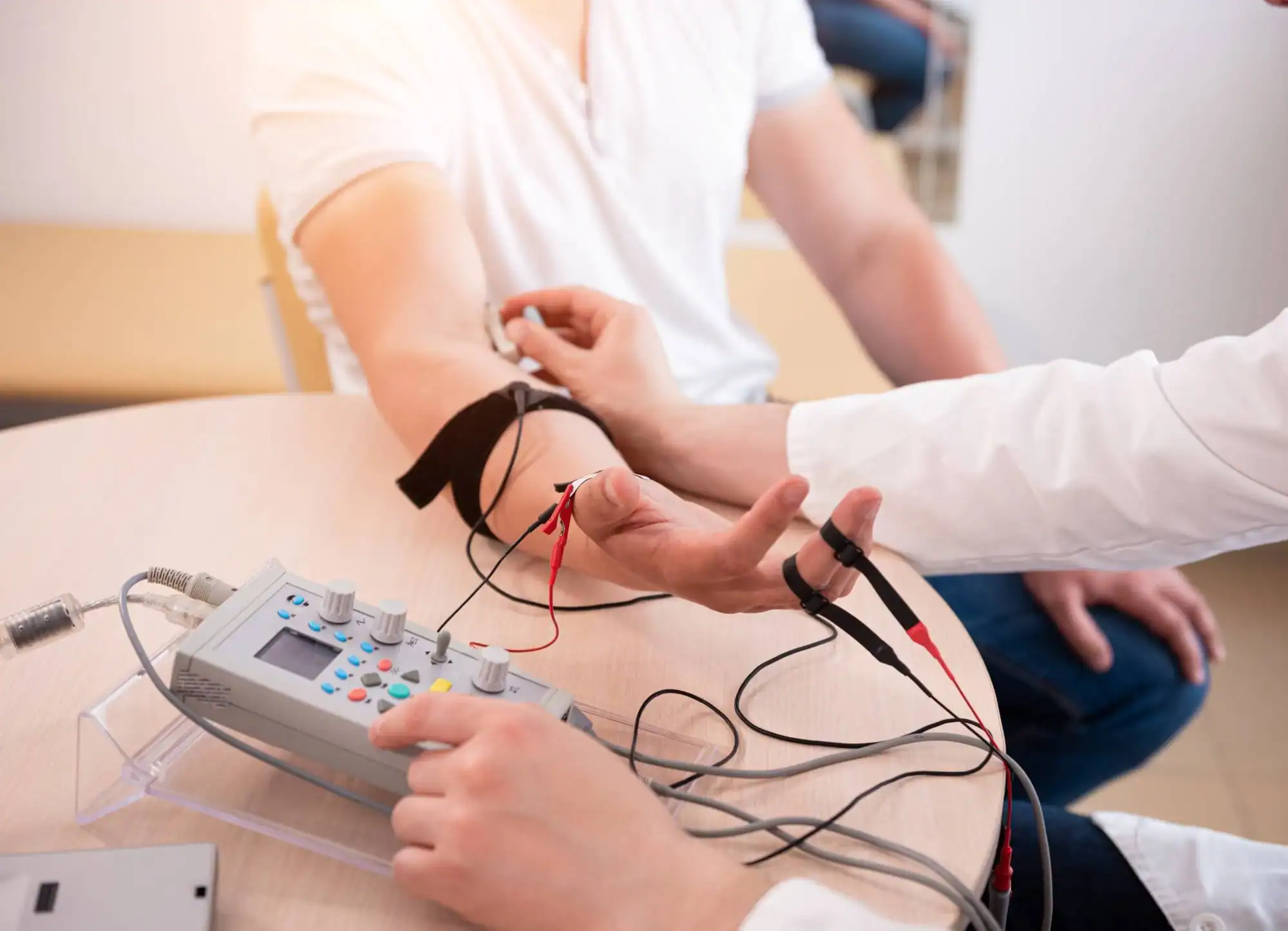
Electrodiagnostic testing is often the piece that clarifies things. Nerve conduction studies and EMG measure how well signals travel along your nerves and how the muscles respond. They can confirm neuropathy, describe whether the problem lies in the coating of the nerve fiber or the fiber itself, show how widespread it is, and distinguish a peripheral neuropathy from a pinched nerve in the spine, which can produce similar symptoms and is treated completely differently. That distinction is not academic. It changes the entire plan.
Treatment then runs on two tracks at once. The first addresses the cause, whether that means tighter blood sugar control, correcting a deficiency, changing a medication, treating a thyroid problem, or reducing alcohol. The second addresses symptoms and function, and includes medications developed specifically for nerve pain, topical options, physical therapy for balance and strength, footwear and skin protection, and for a small number of patients with severe pain that has not responded to anything else, spinal cord stimulation. Nobody should promise you full reversal of established nerve damage. What is realistic is slowing progression, protecting the function you still have, and making the pain livable.
Getting Evaluated Before The Symptoms Settle In
The reason to act on these five signs is not that any one of them is an emergency. It is that neuropathy is a condition where timing changes the outcome. Nerve that is irritated but not yet destroyed can often recover once the cause is addressed. Nerve that has been damaged for years usually cannot. Every month spent with an untreated cause is a month spent moving in the wrong direction.
If you recognized yourself in the spreading numbness, the burning that wakes you, the unsteadiness in the dark, the weakness you have been explaining away, or the injury you never felt happen, the useful next step is an evaluation that looks for a reason rather than a medication that covers the symptom.
At NY Spine Medicine, we perform EMG and nerve conduction testing at our Manhattan and Brooklyn offices, and we treat the pain, the balance, and the underlying contributors as one problem rather than three separate visits. If your hands or feet have been telling you something for a while, call 212-750-1155 and let us find out what is behind it.