
Summary:
Vertebral compression fractures rarely announce themselves. Many happen without a fall, sometimes during something as ordinary as lifting a bag of groceries or turning over in bed. What patients notice is a sudden band of pain in the mid or low back that gets sharply worse when they stand up and eases when they lie flat.
That pattern matters, because it is also the pattern that responds best to kyphoplasty. The procedure has an unusually clear set of criteria, and patients who meet them often describe relief within a day or two. Patients who do not meet them are usually better served by something else.
Here is what a spine physician is actually weighing when deciding whether you are a candidate.
What A Vertebral Compression Fracture Actually Feels Like
The classic description is a sudden, sharp, focused pain in the back, often at the level of the lower ribs or just below. It is worse with standing, walking, coughing, and getting out of a chair, and noticeably better lying down. Many patients can point to the exact spot with one finger, which is unusual for ordinary back pain and is a useful clue.
Some fractures are quieter. Osteoporotic fractures can develop gradually and show up as a loss of height, a rounding forward of the upper back, or new difficulty taking a full breath. Others are found incidentally on a chest X-ray ordered for something else entirely. If you are over sixty five, have osteoporosis, take long term steroid medication, or have a history of prior fractures, new persistent back pain deserves imaging rather than a wait and see approach.

Who Is The Ideal Candidate For Kyphoplasty?
The strongest candidate has four things at once. First, a vertebral compression fracture confirmed on imaging, not merely suspected. Second, pain that clearly corresponds to that level, which the physician confirms by pressing over the bone and reproducing your pain. Third, a fracture that is still relatively recent, generally within weeks to a few months. Fourth, pain severe enough that it limits walking, sleeping, or basic independence despite a reasonable trial of rest, bracing, and medication. When those four line up, the decision is usually straightforward.
Age and bone quality matter but do not decide by themselves. Most candidates have osteoporosis or osteopenia, and many are postmenopausal women or older men, but younger patients with fractures related to long term steroid use, certain cancers, or high energy trauma can also be candidates. What actually matters is whether the fracture is the pain generator and whether it is still capable of responding. A fracture that has already healed solid will not respond to cement, no matter how much it hurt last year.
The other thing we look for is trajectory. A patient whose pain is improving steadily week over week will often keep improving without a procedure, and that is a good outcome. A patient whose pain is unchanged after several weeks of conservative care, who cannot get out of bed comfortably, or who is losing strength and independence because of immobility, is the patient for whom kyphoplasty tends to change the picture quickly. Prolonged bed rest is not harmless in older adults. It accelerates bone loss, deconditioning, and pneumonia risk, and that is part of why waiting indefinitely is not a neutral choice.
Why The Timing Of Your Fracture Matters More Than Its Size
Kyphoplasty works by stabilizing a bone that is still moving microscopically. In a fresh fracture, tiny movements at the fracture line are a major source of pain. Cement stops that movement. It also restores some of the lost height in many cases, which can help with posture and with the mechanics of breathing. Once a fracture has fully healed and consolidated, there is nothing left to stabilize, and the procedure has little to offer even if the vertebra still looks collapsed on an X-ray.
That is why the shape of the bone on a plain film is a poor guide on its own. A vertebra can look dramatically wedged and be completely healed and painless. Another can look only mildly compressed and be the source of severe pain. The study that settles it is an MRI, which shows bone marrow edema, the swelling inside the bone that indicates an active, unhealed fracture. When an MRI cannot be done, a bone scan can serve a similar purpose.
Most candidates are treated within the first several weeks to a few months after the fracture. Earlier is not automatically better, because a meaningful number of fractures settle down on their own with time, bracing, and pain control, and those patients do not need a procedure at all. The usual approach is a short period of conservative management with close follow up, then reassessment. If pain remains severe and function is not returning, that is the point where kyphoplasty becomes a reasonable next step rather than a premature one. Older fractures can still be treated when the MRI shows the bone has not yet healed, so the biology matters more than the calendar.
Want live answers?
Connect with a NY Spine Medicine expert for fast, friendly support.
Who Should Not Have Kyphoplasty, And What Fits Better
Kyphoplasty is the wrong answer when the fracture is old and healed, when the back pain is actually coming from arthritic facet joints, a disc, or spinal stenosis rather than the bone, or when imaging shows no fracture at all. It is also inappropriate when there is active infection, either in the spine or elsewhere in the body, or when a bleeding problem cannot be safely controlled.
Certain fracture patterns need a surgeon rather than a needle. Burst fractures with bone pushed back into the spinal canal, fractures accompanied by neurologic symptoms such as leg weakness or bowel and bladder changes, and unstable injuries from significant trauma are managed differently. If a fracture is suspected to be caused by a tumor, the workup comes first, because treating the pain without understanding the cause is a mistake nobody should make twice.

What The Imaging And Workup Before The Procedure Involve
The workup usually starts with plain X-rays, including standing views, which show alignment, the degree of collapse, and whether there are older fractures at other levels. X-rays are quick and useful, but they cannot tell you whether a fracture is new. They also establish a baseline, which matters because new fractures at adjacent levels are common in osteoporotic spines.
The MRI is the deciding study for most patients. It shows marrow edema at the fractured level, confirms how many levels are involved, and rules out other explanations such as a disc herniation, a fluid collection, or a mass. It is common to discover that a patient has three collapsed vertebrae on X-ray but only one that is actually active, and that single level is what gets treated. Where you are tender on exam should match what the MRI shows, and when it does not, we keep looking. Patients with a pacemaker or another device that prevents an MRI can usually have a bone scan instead.
Beyond imaging, the evaluation looks at why the bone broke in the first place. That means a bone density scan if you have not had one recently, blood work to look for treatable contributors such as low vitamin D, and a review of medications that weaken bone. This part gets skipped constantly, and it should not be. Stabilizing one fractured vertebra does nothing to protect the next one. The patients who do best over the long run leave with both a stabilized fracture and a real osteoporosis plan, which usually includes prescription bone therapy, adequate vitamin D and calcium, a fall prevention review at home, and a progressive strengthening and balance program.
What The Procedure And The First Few Weeks Of Recovery Look Like
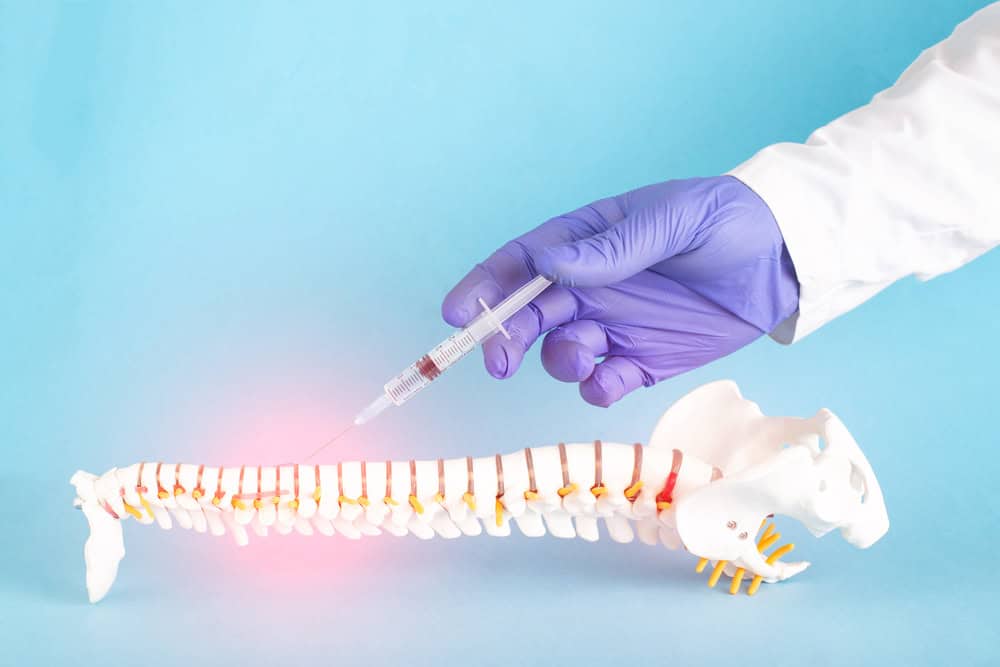
Kyphoplasty is performed through two small skin punctures, not an open incision. You lie face down, and under fluoroscopic guidance a narrow cannula is advanced into the fractured vertebra through the pedicle, the bony bridge at the back of the bone. A balloon is inflated inside to create a cavity and lift the collapsed bone where that is possible, then removed, and bone cement is injected into that cavity under continuous imaging. The cement hardens within minutes.
Most single level cases take under an hour. Sedation or light general anesthesia is typical, depending on your health and your ability to lie flat comfortably. The punctures are usually closed with a small adhesive strip rather than stitches. You will be monitored for a short recovery period and will need someone to drive you home, and nearly everyone goes home the same day.
Pain relief is often noticeable within one to two days, and many patients describe it as the moment they could finally stand up straight without bracing themselves. Some soreness at the entry sites for several days is normal. You will typically be encouraged to walk the same day, avoid heavy lifting and repeated bending for a few weeks, and begin a supervised strengthening program once the initial soreness passes. Your physician may keep you in a brace briefly, though many patients do not need one afterward.
There are real risks and they should be named. Cement can leak outside the vertebra, which is usually harmless but occasionally irritates nearby structures. Infection, bleeding, and reactions to anesthesia are possible with any procedure. There is ongoing discussion in spine care about whether treated levels place additional stress on neighboring vertebrae, which is another reason osteoporosis treatment afterward is not optional. Call the office promptly for fever, new leg weakness or numbness, pain that is worsening rather than improving, or any change in bowel or bladder function.
Finding Out Whether Kyphoplasty Is Right For You
The short version is that kyphoplasty is not a general treatment for back pain. It is a targeted fix for a specific problem, a painful and unhealed vertebral compression fracture in someone whose symptoms have not resolved with conservative care. When those conditions are met, few procedures in spine care produce a faster or more obvious change in a person’s daily life.
The corollary is that the evaluation matters more than the procedure. Getting the right MRI, matching the imaging to the exam, treating the single active level rather than every collapsed one, and building an osteoporosis plan afterward are what separate a good outcome from a repeat visit six months later.
At NY Spine Medicine, we handle that full sequence at our Manhattan and Brooklyn offices, from imaging review and diagnostic workup through the procedure itself and the physical therapy that follows. If you have sudden back pain after a fall, or persistent pain that is worse standing and better lying down, and you want to know whether a fracture is behind it, call 212-750-1155 and we will start with the evaluation.