


Summary:
Nerves are wiring, and wiring can fail in two basic ways. The insulation can break down, which slows the signal. Or the wires themselves can be lost, which weakens it. A nerve conduction study is how those two failures are told apart, and that distinction drives most of what happens next.
This is a more useful description than the one most people are given, which is that the test checks whether your nerves are working. Nerves are rarely simply working or not working. They are conducting at some speed, with some strength, along some part of their course, and the numbers describe exactly where on that spectrum you are.
Here is what those numbers mean, and why they carry so much weight in a diagnosis.
What A Nerve Conduction Study Measures That Imaging Cannot
Imaging is a photograph. A conduction study is a stopwatch and a scale.
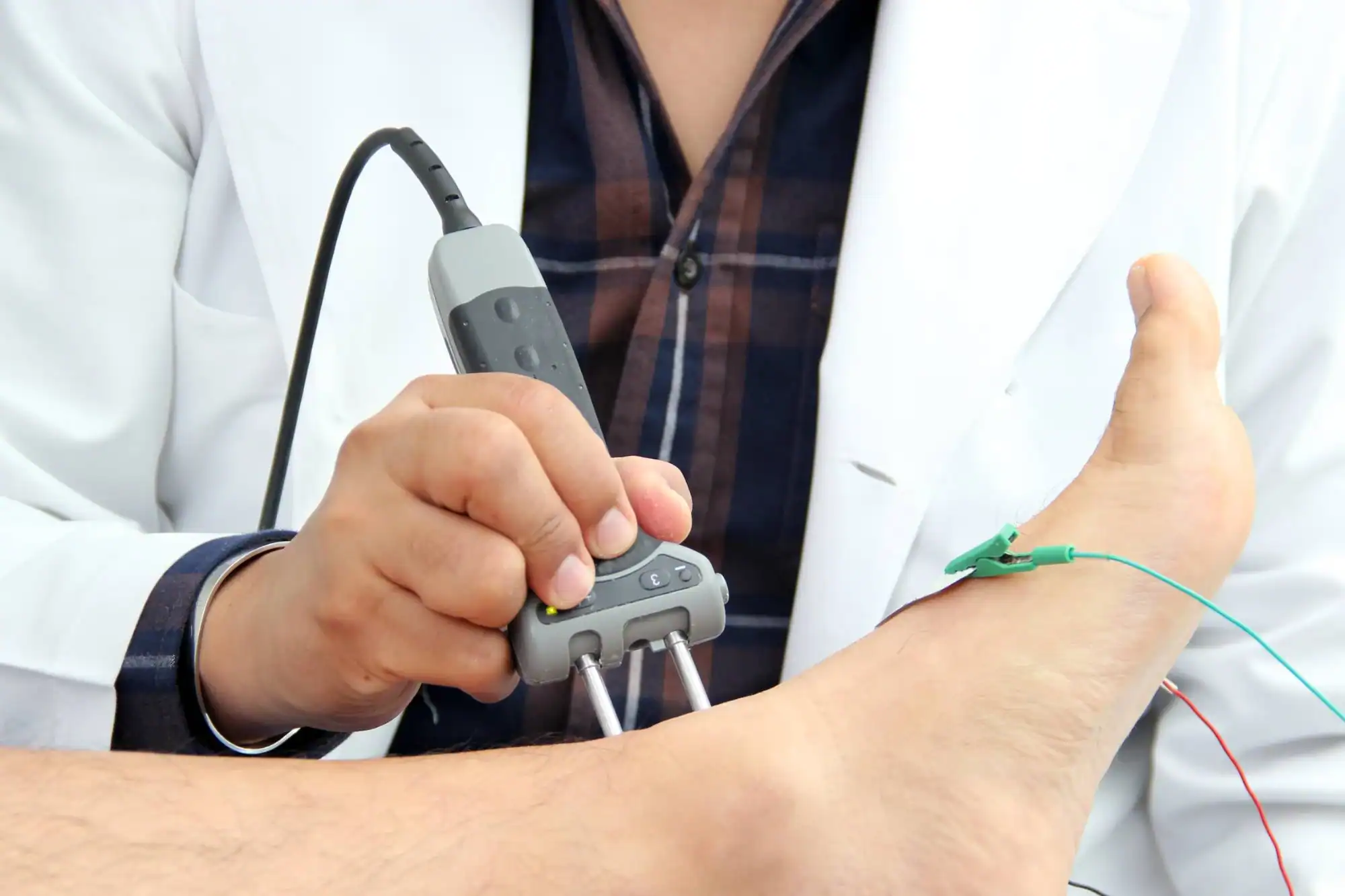
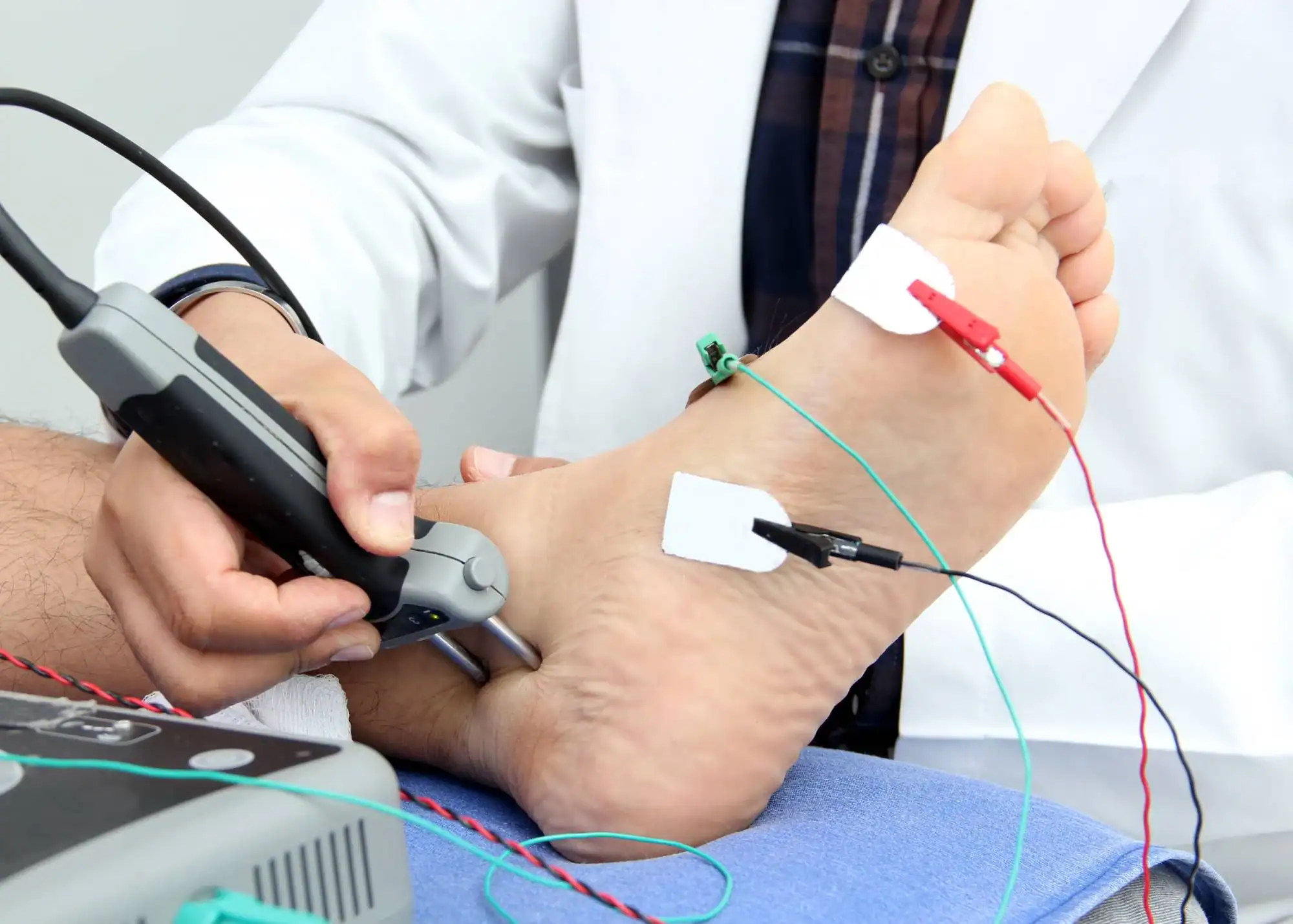
The setup is simple. Recording electrodes are taped to the skin over a muscle or along the path of a sensory nerve. A stimulating electrode delivers a brief electrical pulse somewhere else along that same nerve, and the equipment measures what shows up at the recording site and how long it took to get there. The pulse feels like a quick tap or a snap, and it is over immediately.
By stimulating at several points along one nerve and comparing the results, the study builds a profile of that nerve segment by segment. This is something no scan can offer. An MRI can show a nerve being pressed by something nearby. It cannot tell you whether the signal still gets through, how well it gets through, or at what point along the route the trouble begins.
What Do Latency, Velocity, And Amplitude Actually Mean?
Three numbers do most of the work, and each one answers a different question.
Latency is the delay between the stimulus and the response. It is measured in milliseconds and reflects how long the signal takes to cover a known distance, including the time needed to cross into the muscle. A prolonged latency at one specific site is among the earliest signs of compression, which is why it is so often the first abnormality found in carpal tunnel syndrome.
Conduction velocity is speed, calculated from the distance between two stimulation points and the difference in their latencies. Healthy nerve fibers conduct quickly because of myelin, the fatty insulation wrapped around them, which lets the signal jump along rather than crawl. When myelin is damaged, speed drops. Slowing is therefore the signature of a problem with the insulation rather than with the wire.
Amplitude is the size of the response, seen as the height of the wave. It reflects how many nerve fibers are actually contributing, and by extension how much muscle is responding. Reduced amplitude suggests that fibers have been lost, which is a different and generally more serious kind of injury than slowing.
A fourth observation matters too. If the response spreads out and loses its crisp shape, it suggests that different fibers within the same nerve are arriving at different times, which happens when myelin damage is patchy rather than uniform.
None of these numbers is interpreted alone. They are compared against expected ranges, against the same nerve on your other side, and against the other nerves tested that day, because what counts as normal varies with age, height, and even limb temperature.
Slowed Signals Versus Weakened Signals: Two Kinds Of Damage
This is the distinction the whole study is built around, and it changes both the outlook and the plan.
Demyelinating injury means the insulation is damaged while the underlying nerve fibers remain intact. Speed drops, latencies stretch, and the signal may lose its shape, but amplitude is relatively preserved. This is what compression usually produces early on. It is also the more encouraging finding, because myelin repairs itself reasonably well once the pressure is relieved, and recovery can be fairly quick.
Axonal injury means nerve fibers themselves have been lost. Amplitude falls. Speed may stay close to normal, because the surviving fibers still conduct at their usual rate. This is what prolonged compression eventually causes, and it is also the typical pattern in metabolic neuropathies, including the one associated with diabetes. Recovery here is slower and less complete, because regrowing a nerve fiber is measured in months and it does not always reach where it was going.
Plenty of real studies show both patterns together, which usually means something has been going on for a while and has moved from irritation into damage.
The practical consequence is direct. A slowed but intact nerve often justifies continued conservative treatment, because the ceiling for recovery is high. Evidence of fiber loss usually raises the urgency of relieving whatever is causing it, since waiting has a cost that does not get refunded later.
Want live answers?
Connect with a NY Spine Medicine expert for fast, friendly support.
Why Detecting Nerve Damage Early Changes The Outlook
Nerves are patient up to a point, and then they are not.
A nerve under mild, ongoing pressure will complain first and fail later. In that early window, taking the pressure off, whether by changing an activity, splinting, injecting, or occasionally operating, tends to work well because nothing has been permanently lost.
Once fibers begin to die off, the calculation changes. Treatment can stop further loss and often improves symptoms, but restoring what is gone takes far longer and may be incomplete. Weakness and visible muscle wasting are especially slow to recover.
This is why testing at the right moment beats waiting another year to see whether things settle down. The study tells you which side of that line you are on, and that is not something you can judge by how much it hurts. Pain and damage are only loosely related, and some of the most significant nerve injuries are surprisingly quiet.
How A Study Pinpoints The Exact Spot Where A Nerve Is Trapped
Localization is the most impressive thing a conduction study does, and the method is easier to follow than you might expect.
Imagine a long garden hose with a kink somewhere in the middle. If you measure flow at several points along it, everything above the kink looks normal and everything below is reduced. The kink sits between the last normal measurement and the first abnormal one.
Nerve testing works on that principle. Take the ulnar nerve, which passes through a narrow channel at the inside of the elbow and produces numbness in the small and ring fingers when it is irritated. The nerve is stimulated below the elbow, above the elbow, and sometimes at the wrist and the upper arm as well. If conduction is normal along the forearm but slows across the elbow segment specifically, the trapped point is at the elbow. If everything is slowed evenly, the problem is not local at all and a generalized neuropathy becomes more likely.
The same approach identifies compression of the median nerve at the wrist, the peroneal nerve at the outside of the knee, and the tibial nerve at the ankle. It also separates a peripheral nerve problem from one at the nerve root, because a root problem sits above every point the study can stimulate and therefore produces a different pattern entirely.
Comparing sides adds precision. Your own opposite limb is often the best reference available, since it shares your age, your height, and your circulation.
This is also why the study is tailored as it goes. The technologist and physician follow the findings, adding nerves and stimulation points based on what the earlier measurements showed, which is why the appointment does not run to a fixed length.
What A Normal Nerve Conduction Study Means When Symptoms Are Real
Being told the test was normal when your hands still burn every night is a genuinely difficult moment. It can feel like being told you imagined it.
You did not, and a normal study has several honest explanations.
The most common is small fiber involvement. Standard conduction testing measures large, myelinated fibers. The small fibers that carry burning pain and temperature sensation are not captured by it, so a small fiber neuropathy can produce severe symptoms alongside a completely normal study. Recognizing that possibility calls for different testing and a different conversation.
Another is timing. Very early compression can be intermittent, causing symptoms at night or in certain positions while conduction stays within normal limits during a daytime test. Symptoms often arrive before measurable change does.
Another is that normal ranges are population based. If your baseline conduction was unusually fast, you can lose a meaningful amount of function and still land inside the normal band. Comparing sides helps catch this, which is one reason both limbs are often tested.
And sometimes normal is simply the answer, and that is good news. The symptoms are real, but the cause lies elsewhere, in a joint, a tendon, circulation, or a source of referred pain, and the search should move rather than stall.
What a normal study should never do is end the conversation. It narrows the field considerably, which is valuable. It does not mean nothing is wrong, and any clinician who treats it that way has misread what the test is for.
Getting Your Nerve Symptoms Measured Instead Of Guessed At
The real takeaway is that a nerve conduction study converts vague symptoms into measurements. Speed, delay, and signal strength are not opinions, and they hold up as a baseline you can be compared against later.
A more useful frame: most nerve problems are not a yes or no question. They are a question of how much, where, and what kind, and those answers determine whether you are looking at watchful waiting, a splint, an injection, or a referral for something more definitive.
At NY Spine Medicine, we perform nerve conduction studies and EMG at our Manhattan and Brooklyn offices, and the physician who interprets your study is part of the same practice that will discuss what to do about it. That continuity matters more than it sounds like it should, because these results are read in the context of your history rather than off a sheet of numbers.
If numbness, tingling, or weakness has gone on long enough that you want real numbers rather than reassurance, call us at 212-750-1155.