A work injury doesn’t just hurt it puts your paycheck, your job, and your long-term health in a precarious spot all at once. When you’re a warehouse worker at a distribution facility on Valley Brook Avenue, a dock employee along the Route 3 industrial corridor, or a tradesperson maintaining one of Lyndhurst’s many pre-war homes, you need a physician who can accurately identify what happened to your body and document it in a way that protects your claim.
What you get with us at NY Spine Medicine is a physician who can distinguish between a simple muscle strain and a herniated disc with nerve involvement and that distinction matters enormously, both for how you heal and for how your claim is processed. The Route 3 and Route 17 corridor that defines Lyndhurst’s industrial identity brings with it real physical demands: heavy lifting, repetitive strain, forklift work, slip-and-fall risks on loading docks. Those aren’t minor inconveniences. They’re the kinds of injuries that, left under-evaluated, turn into permanent problems.
If you live in Lyndhurst and commute into New York City via the NJ Transit Main Line, and you were injured at a New York worksite, your claim falls under New York State workers’ compensation law not New Jersey’s. We operate in Manhattan and are equipped to handle exactly that scenario, so you’re not left navigating a jurisdiction gap on your own while you’re already dealing with pain and missed work.
We built NY Spine Medicine around a straightforward belief: surgery should be the absolute last resort, and every non-surgical option should be exhausted before it’s ever considered. That philosophy matters a lot when you’re a Lyndhurst resident whose livelihood depends on physical capacity whether you’re working the docks off Route 3, running a trades business out of Bergen County, or commuting into Manhattan every morning on the Main Line.
Dr. Douglas Schottenstein is one of only approximately 200 physicians in the entire United States who holds double board certification in both neurology and interventional pain management. That’s a verifiable credential that directly affects the quality of your diagnosis and the strength of your claim documentation. He’s also been named to the Castle Connolly and New York Magazine Best Doctors lists for 10 consecutive years, holds an academic appointment at Weill Cornell Medicine, and completed his fellowship at Columbia University/NewYork-Presbyterian Hospital.
For Lyndhurst workers whether injured locally or at a New York job site that level of specialization is available to you. We handle all documentation and communication with your employer and insurer, so you can focus on getting better instead of decoding paperwork.

The process starts simply: you reach out to us at NY Spine Medicine, and we connect you with a qualified workers’ compensation physician quickly. There’s no lengthy referral chain or weeks-long wait. For Lyndhurst residents, that matters whether you’re dealing with a back injury from a warehouse shift near the Kingsland redevelopment zone or a neck injury sustained at a Manhattan construction site, time affects both your recovery and your claim’s viability.
Once you’re connected with a physician, a thorough evaluation begins. Because Dr. Schottenstein’s training spans both neurology and interventional pain management, the evaluation goes deeper than a standard urgent care assessment. If your injury has a nerve component radiculopathy, nerve compression, or referred pain that gets identified and documented properly from the start, not discovered months later when your claim is already in dispute.
From there, your treatment plan is built around what your injury actually requires. That might mean minimally invasive procedures like nerve blocks, epidural steroid injections, or radiofrequency ablation. It might mean a structured combination of interventional care and physical therapy. What it won’t mean is a push toward surgery before every other option has been genuinely explored. Throughout the process, we manage the paperwork and insurer communication a significant relief for workers who already have enough to deal with.
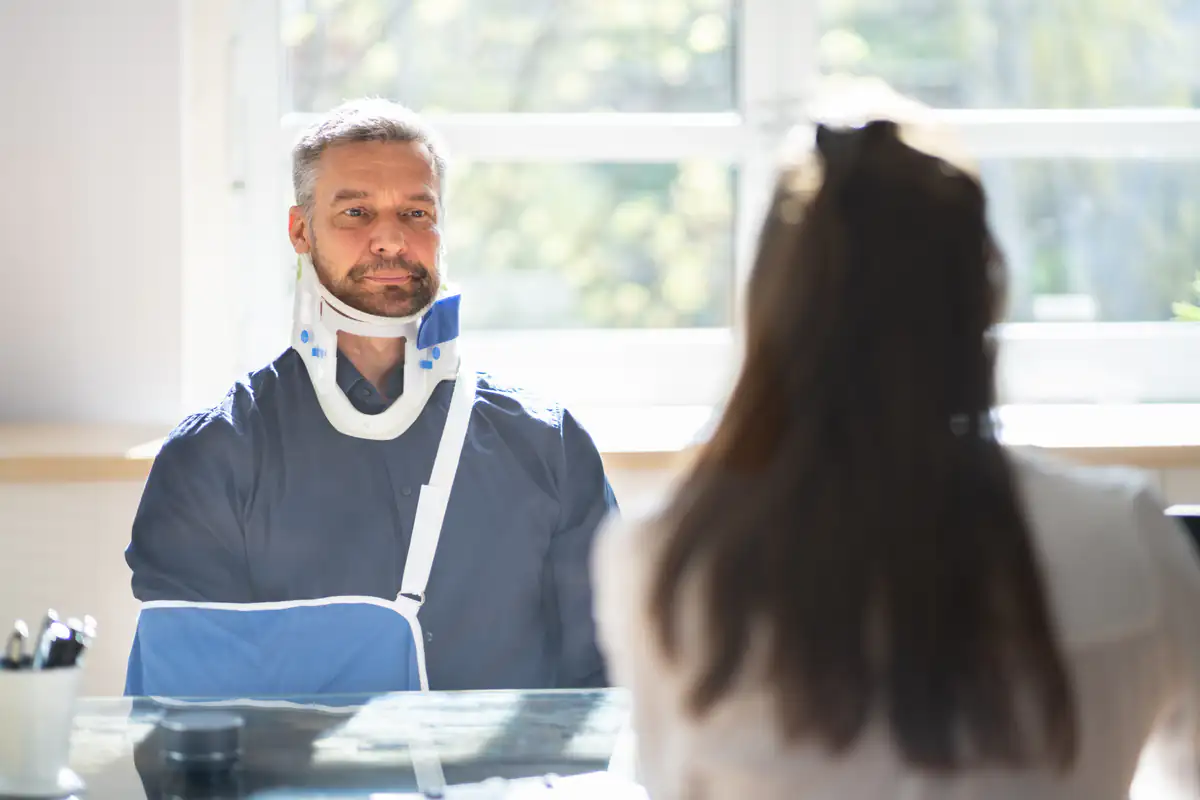
Ready to get started?
The injuries that come out of Lyndhurst’s industrial corridor the distribution centers, the construction sites tied to the NJSEA Kingsland Redevelopment Plan, the warehouse facilities along Valley Brook Avenue tend to involve the spine, the neck, and the nervous system. Lifting injuries, repetitive strain, slip-and-falls on loading docks, and struck-by incidents don’t always show up clearly on a basic X-ray.
Our approach goes further, using interventional diagnostics and treatment that identifies the neurological root cause of your pain, not just the surface-level symptoms. For Lyndhurst residents who commute into New York on the NJ Transit Main Line and were injured at a New York worksite, our Manhattan office at 18 East 48th Street is directly accessible via the newly rebuilt Lyndhurst Station the same train route many of you already take to work every day. We operate within the NY WCB-authorized system that governs claims for injuries sustained at New York job sites.
Treatment options we offer include epidural steroid injections, transforaminal nerve blocks, facet joint injections, sacroiliac joint injections, radiofrequency ablation, spinal cord stimulation, and more all minimally invasive, all aimed at resolving pain and restoring function without defaulting to surgery. We also coordinate all insurer and employer communication on your behalf, which is particularly valuable for Lyndhurst workers navigating the complexity of a New York workers’ comp claim while living in New Jersey.

This is one of the most common points of confusion for Bergen County commuters, and it’s worth getting right before you do anything else. In general, if you were injured at a worksite physically located in New York State, your workers’ compensation claim falls under New York State law and is governed by the New York Workers’ Compensation Board not New Jersey’s Division of Workers’ Compensation. That means you need a physician who is authorized under the New York WCB system, not just any doctor in New Jersey.
Where it gets nuanced is that some claims can involve both states depending on where your employment contract was formed and where you primarily work. If you’re unsure which jurisdiction applies to your specific situation, the safest first step is to contact a workers’ comp attorney in New Jersey or New York for a quick consultation before filing. We at NY Spine Medicine operate as a New York workers’ compensation medical provider, so if your claim falls under NY jurisdiction, we’re equipped to handle your care and documentation correctly from day one.
Under New York workers’ compensation law, your employer cannot simply dictate which doctor you see. You have the legal right to choose any physician who is authorized by the New York Workers’ Compensation Board. The one exception involves employer-established Preferred Provider Organizations if your employer uses a PPO, you’re generally required to start treatment within that network. However, after 30 days, you’re free to switch to any WCB-authorized provider you choose.
For New Jersey workers’ comp claims, the rules are somewhat different, and your employer may have more initial control over the authorized treating physician. This is another reason why knowing which jurisdiction applies to your injury matters early in the process. If you were injured at a New York worksite and your employer is trying to direct you to a specific doctor, you may have more rights than you realize. Connecting with a workers’ comp attorney alongside a qualified NY workers’ compensation medical provider like ours is the most effective way to protect both your health and your claim from the start.
This distinction can directly determine whether your workers’ comp benefits are protected or reduced, so it’s worth understanding clearly. Your treating physician the doctor you choose to manage your care works for you. Their job is to accurately diagnose your injury, document your condition thoroughly, and create a treatment plan designed to help you recover. Their records become the primary medical evidence supporting your claim.
An Independent Medical Examination doctor, on the other hand, is selected and paid by the insurance carrier. Despite the word “independent” in the title, IME physicians are hired specifically by the insurer, and their reports frequently minimize the severity of injuries or recommend that benefits be reduced or terminated. Having a treating physician whose documentation is detailed, clinically rigorous, and grounded in genuine specialist-level evaluation is your most important defense against an IME report that doesn’t reflect your actual condition. For Lyndhurst workers dealing with spine, nerve, or musculoskeletal injuries from warehouse or construction work, this is not a minor administrative concern it can be the difference between receiving full benefits and having your claim disputed.
We handle all communication and documentation with your employer and insurance carrier on your behalf. That includes the clinical documentation that supports your claim, correspondence with the insurer, and the records that get submitted as part of the workers’ compensation process. For most injured workers especially those dealing with the physical demands of warehouse, dock, or construction work along Lyndhurst’s Route 3 industrial corridor that administrative burden is the last thing you want to manage while you’re in pain and potentially out of work.
The workers’ compensation system involves specific forms, documentation deadlines, and insurer communication requirements that can feel overwhelming if you’ve never navigated them before. Missing a deadline or submitting incomplete documentation can create real problems for your claim, even if your injury is legitimate and well-documented medically. Having a physician and practice that understand the system and manage that process for you isn’t a luxury it’s a practical advantage that protects your claim from the kinds of procedural issues that insurers look for when disputing benefits.
We specialize in spine and pain conditions, which happen to be the most common categories of serious work injury in the industrial and distribution employment base that defines much of Lyndhurst’s workforce. Back injuries from heavy lifting, herniated discs from repetitive strain, neck injuries from falls or vehicle incidents, nerve compression from awkward sustained postures, and radiculopathy from acute trauma these are all within our core clinical expertise.
Beyond the Meadowlands industrial corridor, Lyndhurst also has a substantial trades workforce that services the town’s aging housing stock homes built before 1950 make up a significant portion of the township’s residential inventory. Roofers, plumbers, electricians, and carpenters working on these older structures face injury risks that frequently involve the spine and nervous system in ways that a general practitioner or urgent care physician isn’t fully equipped to evaluate. The double board certification in both neurology and interventional pain management means that when a nerve is involved in your injury which is more common than most people realize it gets identified and treated correctly rather than missed or misclassified.
More easily than you might think. Our Manhattan office is located at 18 East 48th Street right in Midtown. For Lyndhurst residents, the NJ Transit Main Line runs directly from the newly rebuilt Lyndhurst Station, which reopened in June 2025, into Hoboken Terminal. From Hoboken, you can connect to Midtown Manhattan via the PATH train or ferry, putting you within a short walk of the office. If you’re already a Manhattan commuter, this is the same route you take to work.
For those who drive, the Route 3 corridor connects Lyndhurst directly to the Lincoln Tunnel approach, making the Midtown Manhattan office accessible by car as well. We understand that injured workers have real logistics to manage especially when mobility is limited by the injury itself and our goal is to make accessing specialist-level care as straightforward as possible. If you’re uncertain about how to get there or whether the commute works for your situation, calling us directly at (212) 750-1155 is the fastest way to get that question answered and get your first appointment scheduled.