

Summary:
Most people who end up having an EMG for muscle weakness have already been told several things. That it is age. That it is deconditioning. That it might be their thyroid. Sometimes one of those is right.
The trouble is that weakness is a final common pathway. A dozen different problems arrive at the same complaint, and a physical examination can only take you so far in sorting them. Blood tests help, but they can be normal in real muscle disease and mildly abnormal in people who are perfectly fine.
Electromyography looks directly at the electrical behavior of muscle tissue while it works. That is a different kind of information from anything else in the workup, and it is usually what moves a case from theories to a direction.
When Muscle Weakness Needs More Than A Physical Exam
There are patterns of weakness that make an experienced clinician want objective testing rather than another six weeks of watching and waiting.
Weakness closer to the trunk than to the hands and feet is one. Difficulty rising from a low chair, climbing stairs, or reaching into an overhead cabinet points to the large muscles around the hips and shoulders, which is a typical distribution for muscle disease. Weakness that affects both sides fairly evenly is another. So is weakness without much numbness, since muscle disorders usually leave sensation intact while nerve disorders often do not.
Other prompts include muscle aching or cramping that is out of proportion to the activity, dark colored urine after exertion, unexplained elevations in muscle enzymes on bloodwork, and weakness that fluctuates noticeably through the day, which raises a different set of questions again.
None of these confirms anything on its own. Together they are enough to justify a test rather than a guess.
How Does EMG Tell Muscle Disease From Nerve Disease?
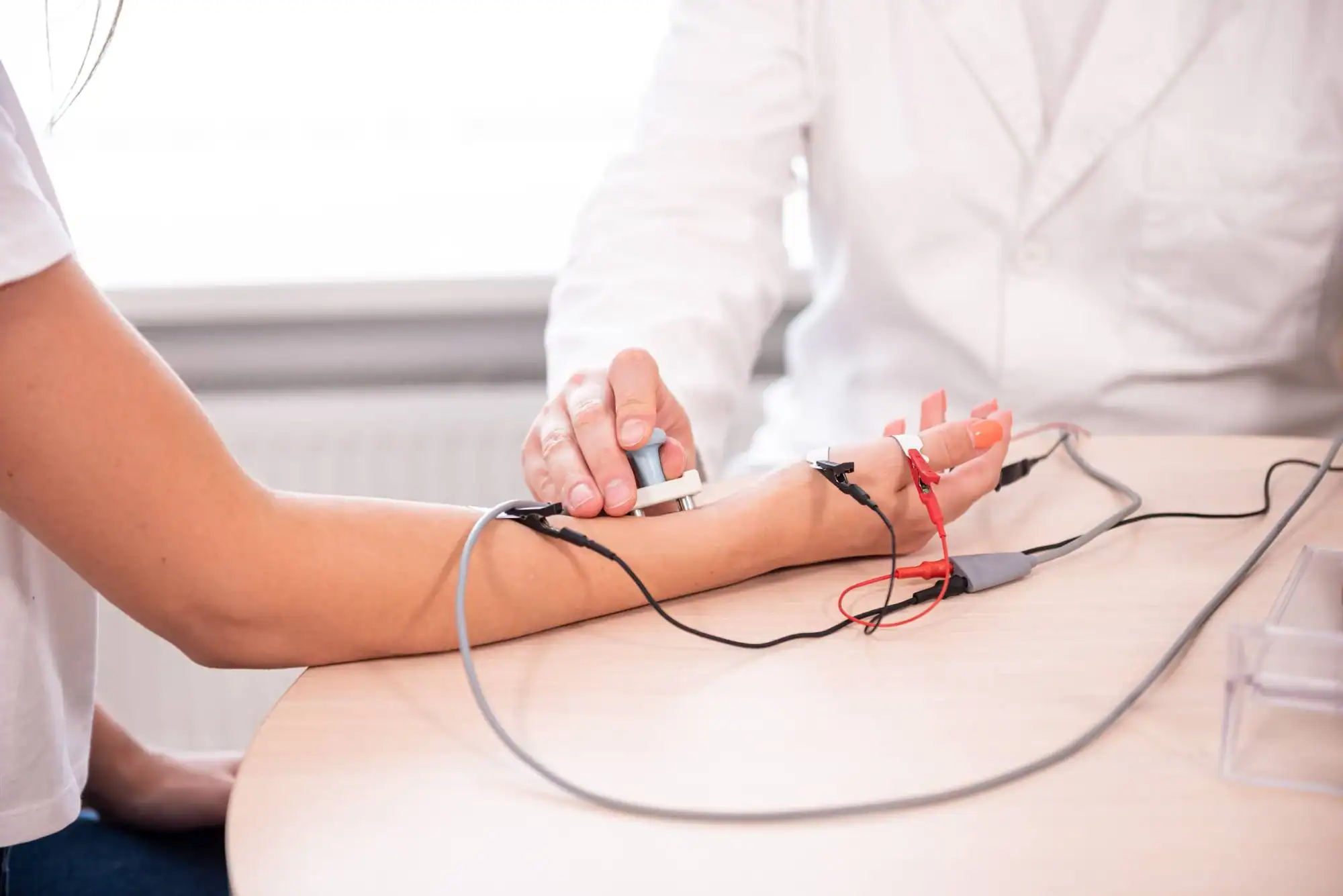
The needle portion of the study records the electrical signal a muscle produces when it contracts. Individual muscle fibers are grouped into units, each unit controlled by a single nerve fiber, and each unit produces a characteristic electrical shape on the screen.
Those shapes change in predictable ways depending on what has gone wrong.
In a muscle disorder, individual fibers within a unit are damaged or lost. The unit still fires normally on command, but there is less muscle behind each signal, so the electrical shapes tend to be smaller and briefer than expected. To generate any real force, the body has to recruit many units at once even for a light effort, which produces a busy pattern at low levels of contraction.
In a nerve disorder, the opposite happens. Whole units drop out because their nerve supply is lost. Surviving nerve fibers sprout and take over orphaned muscle fibers, so each remaining unit becomes larger than normal and its electrical shape grows taller and longer. Fewer units are available, so recruitment looks sparse rather than busy, with individual units firing rapidly to compensate.
There are also findings that show up at rest. Electrical activity in a resting muscle, which should be quiet, can indicate active fiber damage. It occurs both in inflammatory muscle disease and in recent nerve injury, so it is read alongside everything else rather than on its own.
Add the nerve conduction study, which tests the wiring rather than the muscle, and the picture usually resolves. Normal conduction with abnormal muscle findings points at the muscle. Abnormal conduction points at the nerve. Distinctive changes with repeated stimulation point at the junction between the two, which is a third category altogether.
The Patterns That Point Toward A Muscle Disorder Rather Than A Nerve One
Beyond the electrical shapes, the distribution of the findings carries a great deal of weight.
Muscle disorders tend to affect muscles closest to the trunk first, and to do so on both sides. If the shoulder, hip, and thigh muscles all show changes while the hands and feet look normal, that distribution alone argues for muscle rather than nerve, because no single nerve or nerve root supplies that particular combination.
Nerve disorders follow anatomy instead. A single nerve produces findings in the muscles it supplies and nowhere else. A nerve root produces findings in muscles that share that root even though different nerves supply them. A generalized neuropathy usually shows up in the feet first and works upward, because the longest nerves are affected earliest.
The sensory examination is the other divider. Muscle disease does not cause numbness. If someone has weakness and numbness together, the problem is very unlikely to be confined to muscle.
What EMG cannot do is name the specific disease. It can say that the pattern is myopathic, meaning muscle based, and it can say whether there are features suggesting inflammation. It usually cannot separate an inflammatory myopathy from a metabolic one, a medication effect, or an inherited condition. That is where the study hands off to bloodwork, sometimes to genetic testing, and occasionally to a muscle biopsy.
Knowing that boundary is useful. A patient expecting a disease by name from an EMG will be frustrated. A patient expecting a category, and a much shorter list of possibilities, gets what the test is genuinely good at.
Want live answers?
Connect with a NY Spine Medicine expert for fast, friendly support.
What A Muscle Pattern Changes About The Rest Of The Workup
A myopathic result redirects everything downstream, and it does so quickly.
The bloodwork changes. Muscle enzymes, thyroid function, vitamin D, and inflammatory markers all become relevant, and specific antibody testing may be added when an inflammatory muscle disease is suspected.
The medication review changes. Several common drug classes can injure muscle, and a careful look at what someone started taking in the months before the symptoms began is one of the higher yield steps in the entire evaluation.
The rehabilitation changes too. Exercise still matters in most muscle conditions, but the intensity and the type have to be chosen carefully, because some conditions respond badly to aggressive loading.
Which Muscle Complaints Are Worth Testing, And Which Are Not
Not every tired or aching muscle needs an electrical study, and it is worth being honest about that.
Testing tends to be worthwhile when there is objective weakness, meaning weakness a clinician can demonstrate rather than only a feeling of being weak. When symptoms are clearly progressing. When muscle enzymes are elevated without explanation. When someone cannot rise from a chair without pushing off with their arms, has started tripping, or has noticed visible thinning of a muscle. When there is a family history of a muscle condition. And when a diagnosis has been assumed for years without ever being confirmed.
Testing is less likely to help when the main complaint is fatigue rather than weakness and strength is objectively preserved. Those are different problems, and fatigue has a long list of causes this study does not address. It is also less useful for diffuse aching without weakness, for soreness that follows unaccustomed exercise, and for pain that is clearly coming from a joint or a tendon.
There is a middle group where the answer depends on the details. Cramping, exercise intolerance, and episodic symptoms sometimes reflect a metabolic muscle disorder and sometimes reflect ordinary deconditioning. In those cases the decision usually comes down to whether anything on examination or on bloodwork supports the concern.
If someone recommends the test, it is entirely fair to ask what they expect it to show and what they would do with either answer. In cases where the test is genuinely indicated, a good answer to that question exists.
Living With The Answer: Treatment, Monitoring, And Realistic Expectations
Finding the pattern is the beginning of the work rather than the end of it.
Some muscle disorders are treatable in a direct sense. Inflammatory muscle diseases are managed with medication aimed at the immune system, and strength often improves. Thyroid related muscle weakness improves when the thyroid is corrected. Muscle injury caused by a medication frequently resolves once that medication is changed, which is exactly why the drug review matters so much.
Others are managed rather than reversed. Inherited and metabolic muscle conditions are approached through activity strategies, protecting function, adapting how tasks are done, and monitoring for the complications that particular condition tends to produce. That is less satisfying than a cure, but it is a long way from nothing, and it beats spending years not knowing what you are dealing with.
Repeat testing is sometimes used to follow a condition over time, though it is not automatic. More often, strength testing, function, and bloodwork are the practical way to track progress, and the EMG is repeated only when the picture changes in a way that raises a new question.
Rehabilitation deserves specific mention because it is so often mishandled. Muscles that are weak from disease still benefit from being used, and prolonged rest reliably makes things worse. The programming has to respect the condition, avoid pushing into damage, and focus on the movements that matter for daily life. That is a different exercise plan from the one a healthy person would be handed, and it should be built by someone who knows the diagnosis.
Certain developments should not wait for a follow up appointment. Weakness that worsens quickly over days, trouble swallowing, shortness of breath while lying flat, dark colored urine after exertion, or new weakness alongside a fever all need prompt medical attention.
Turning Unexplained Weakness Into A Working Diagnosis
The real takeaway is that the value of electromyography in muscle disorders is not that it names the disease. It is that it tells you which family of problems you are in, and it does that early enough to matter.
A better way to frame it: most people with unexplained weakness are not short of opinions. They are short of a category. Once the study shows that the problem is muscle rather than nerve, or nerve rather than muscle, the number of possibilities collapses and the next tests become obvious instead of exploratory.
At NY Spine Medicine, we perform EMG and nerve conduction testing at our Manhattan and Brooklyn offices, and our physicians read the study with your history and examination in front of them rather than in isolation. When the findings point outside what we treat, we say so and help you get to the right specialist instead of stretching the result to fit.
If weakness has been explained away more than once and you still do not have an answer, call us at 212-750-1155 and let us take a proper look.