

Summary:
Most people use the word pain as though it means one thing. In clinical terms it covers two quite different situations, and the treatment that works beautifully for one can be nearly useless for the other.
If you have hurt for months, you have probably noticed this yourself. The advice that helped in the first two weeks, rest it, ice it, take something for the inflammation, stopped doing much a long time ago. That is not because you did it wrong. It is because the problem has changed character.
Here is what actually separates acute from chronic pain, what happens in between, and why that boundary shapes every sensible treatment decision that follows.
Acute Pain And Chronic Pain Are Not The Same Problem
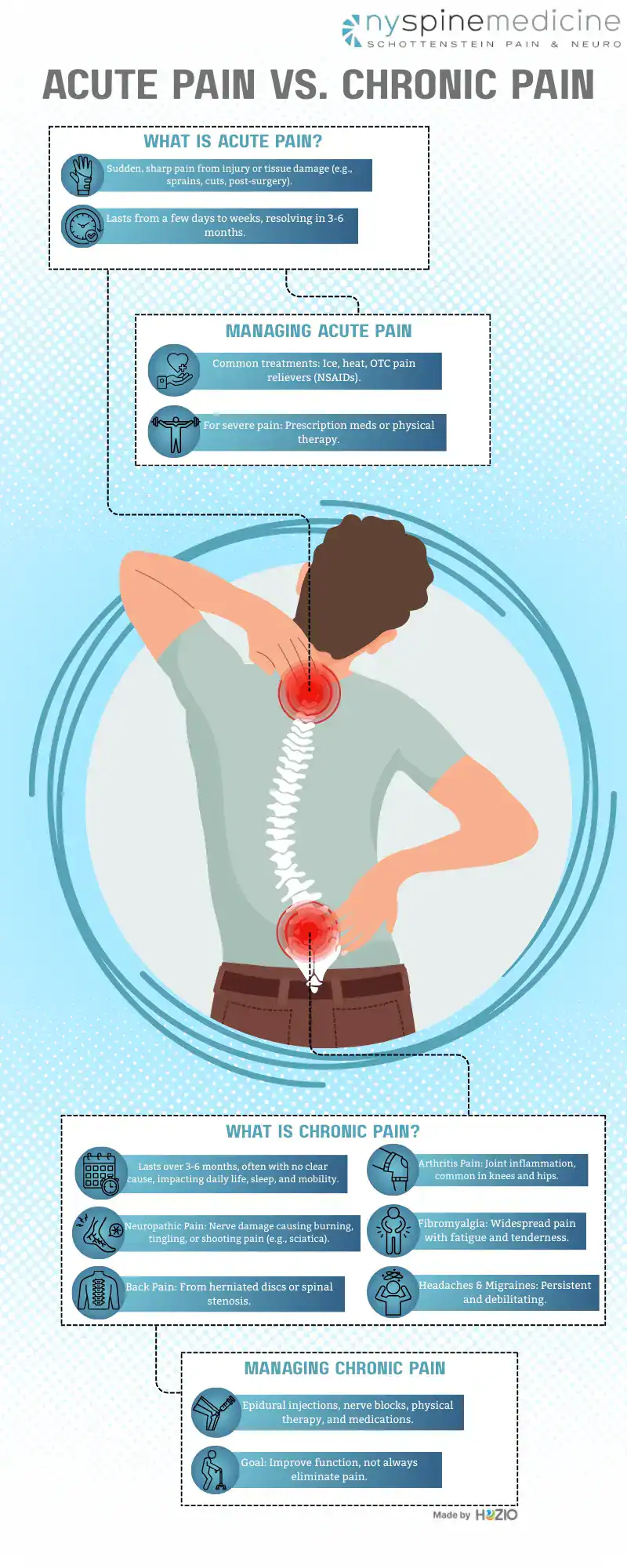
Acute pain is the kind everyone recognizes. You lift something badly, you twist an ankle, you have a procedure, and pain arrives promptly and proportionately. It is a protective alarm. It limits how much you use the injured part, which is useful while tissue repairs, and it settles as healing progresses. The timeline is generally days to weeks, sometimes a couple of months for more substantial injuries.
Chronic pain is pain that has outlasted that process. The usual working definition is pain persisting beyond three months, or beyond the point at which the original injury would reasonably have healed. At that stage the pain is no longer functioning as a useful alarm. It may be maintained by ongoing irritation of a specific structure, by changes in how the nervous system processes signals, or, very often, by both at once.
When Does Acute Pain Become Chronic Pain?
There is no single moment when one becomes the other, which is part of why the transition is so easy to miss. The three month mark is a convention rather than a biological switch. What actually happens is gradual, and it usually starts well before anyone has used the word chronic.
The transition tends to involve several things at once. The original tissue problem may not have fully resolved, perhaps because the mechanical cause was never addressed. Movement patterns have shifted, so other structures are now working harder and complaining. Sleep has become poor, which lowers pain tolerance. Activity has been reduced, so strength and tolerance have dropped, meaning ordinary tasks now provoke symptoms that they would not have provoked before.
Alongside all of that, the nervous system adjusts. Nerves that carry pain signals can become more easily triggered, and the spinal cord and brain can become more efficient at transmitting and amplifying those signals. This is often described as sensitization. It is a real, physical change, not a matter of imagination or attitude, and it explains why pain can persist even when the original injury has healed.
Some factors make this transition more likely. Severe pain at the outset, long periods of inactivity, poor sleep, high stress, fear of movement, and pain that was never properly diagnosed all tend to increase the risk. That is precisely why we would rather see someone at the eight week mark than at the eight month mark. Early, accurate diagnosis is one of the more reliable ways to keep acute pain from settling in.
What Changes In The Nervous System When Pain Persists
It helps to think of the pain system as having a volume control rather than a simple on and off switch. In acute injury, the volume is turned up appropriately, because the signal is worth hearing. When pain persists, that volume setting can stay high even after the reason for it has faded.
Practically, this shows up in ways patients describe long before anyone names them. Light touch or pressure that should not hurt now does. The painful area seems to have spread beyond where the original problem was. Pain fluctuates with sleep, stress and mood in a way that feels illogical. Flares appear without an obvious trigger. None of this means the pain is fabricated. It means the system that reports pain has become more reactive.
There is a second layer. When a nerve itself is irritated or compressed, by a disc, by narrowing of the canal, by scar tissue, the pain often takes on a burning, electrical or shooting quality, and it may bring numbness, pins and needles or weakness. That is neuropathic pain, and it responds to different measures than the deep aching pain of an irritated joint.
Distinguishing between these layers is a large part of what a pain physician is doing during your evaluation. A structure that can be treated directly is worth identifying and treating. A nervous system that has become sensitized needs a different kind of attention, usually graded activity, sleep repair, and sometimes medication aimed specifically at nerve pain. Most people with long standing pain have some of each, and the proportions matter.
Want live answers?
Connect with a NY Spine Medicine expert for fast, friendly support.
Why The Distinction Changes The Whole Treatment Plan
For acute pain, the plan is usually simple and short. Protect the area briefly, keep moving within reason, manage inflammation, and expect steady improvement. The measure of success is that the pain goes away. Most acute pain cooperates with this, and the main mistakes are resting too much and imaging too early.
For chronic pain, that framing sets people up for disappointment. The realiztic goal shifts from eliminating pain to restoring function and reducing pain substantially and durably. The plan runs over months rather than days, it addresses several contributors at once, and it usually pairs something that lowers the pain now, such as a targeted injection, with something that rebuilds capacity over time, such as structured rehabilitation. Judging chronic pain care by whether the pain hit zero this week is judging it by the wrong measure.

How Acute Pain Is Treated, And Why That Approach Stops Working
In the acute phase, most people do well with relative rest for a day or two, gradual return to activity, over the counter anti inflammatory measures where appropriate, heat or ice according to preference, and a short course of physical therapy if things are slow to settle. Imaging is usually unnecessary early on unless there are warning signs. This approach works because the underlying problem is genuinely healing.
Applying the same approach at month six tends to fail, and it fails in a specific way. Rest, which was mildly helpful early, now removes the loading that tissue needs to regain tolerance. Anti inflammatory measures do less because inflammation is no longer the main driver. Passive treatment, where things are done to you rather than with you, produces relief that lasts hours rather than weeks. People conclude that nothing works, when what is really happening is that the treatment no longer matches the problem.
There is also a diagnostic issue. Acute pain often does not need a precise anatomical answer, because it resolves either way. Chronic pain does. If pain has lasted months, it is worth knowing whether it is coming from a facet joint, a disc, the sacroiliac joint, a compressed nerve root or a combination, because each of those has a different targeted treatment. This is where diagnostic blocks, EMG and nerve conduction testing and careful examination earn their place.
The other thing that changes is the role you play. Acute pain is largely something you wait out. Chronic pain is something you actively manage, with a plan you understand and participate in. That shift, from patient as recipient to patient as participant, is one of the strongest predictors of how well the next six months go.
What Effective Chronic Pain Management Actually Involves Day To Day
A good chronic pain plan usually has several strands running in parallel rather than one intervention carrying all the weight. The first strand is targeted treatment of any structure still generating pain. Where a specific source has been identified, an epidural steroid injection, a facet block, a nerve block or radiofrequency ablation can reduce the signal enough to make everything else possible.
The second strand is movement, and it is the one that determines whether relief lasts. Physical therapy for chronic pain looks different from acute rehabilitation. It is built around graded exposure, meaning activity is increased in steps small enough that your system does not flare, and consistent enough that tolerance genuinely climbs. Progress is measured in what you can do, not only in how you feel on a given afternoon.
The third strand is everything that sets the baseline. Sleep is the big one, because poor sleep reliably lowers pain thresholds and the two feed each other. Stress management matters for the same reason. Pacing, meaning distributing activity across the day rather than doing everything on good days and collapsing afterwards, prevents the boom and bust cycle that keeps many people stuck.
Medication has a place, but a narrower one than people expect. Certain medications work specifically on nerve pain and are quite different from ordinary painkillers. Long term opioid therapy is used far more cautiously than it once was, for good reason. Any medication decision belongs with your physician, who knows your full history.
Finally, the plan needs checkpoints. What are we expecting in six weeks, and what do we do if it does not happen? A plan without review points is not a plan, it is a hope.
Getting The Right Kind Of Care For The Kind Of Pain You Have
The distinction between acute and chronic pain matters because it decides what good care looks like. Acute pain is a signal about tissue, and it generally responds to time, sensible movement and patience. Chronic pain is a condition in its own right, involving both the structures that hurt and a nervous system that has learned to amplify, and it needs a plan built for months rather than days.
If you recognize yourself in the second description, the useful thing to know is that persistent pain is not evidence that nothing can be done. It usually means the problem was never made specific enough. At NY Spine Medicine, our physicians work to identify exactly which structures are still involved, using examination, imaging, electrodiagnostic testing and diagnostic blocks, and then combine interventional treatment with in house physical therapy at our Manhattan and Brooklyn offices so that pain relief and rebuilding happen together rather than in separate silos.
If your pain has outlasted the timeline anyone predicted, it is worth having it looked at properly. Call us at 212-750-1155 to arrange an evaluation.