

Summary:
Numbness, tingling, weakness, and burning are frustrating symptoms to bring to a doctor, because they are impossible to see. You can describe them. Nobody can look at your arm and confirm them.
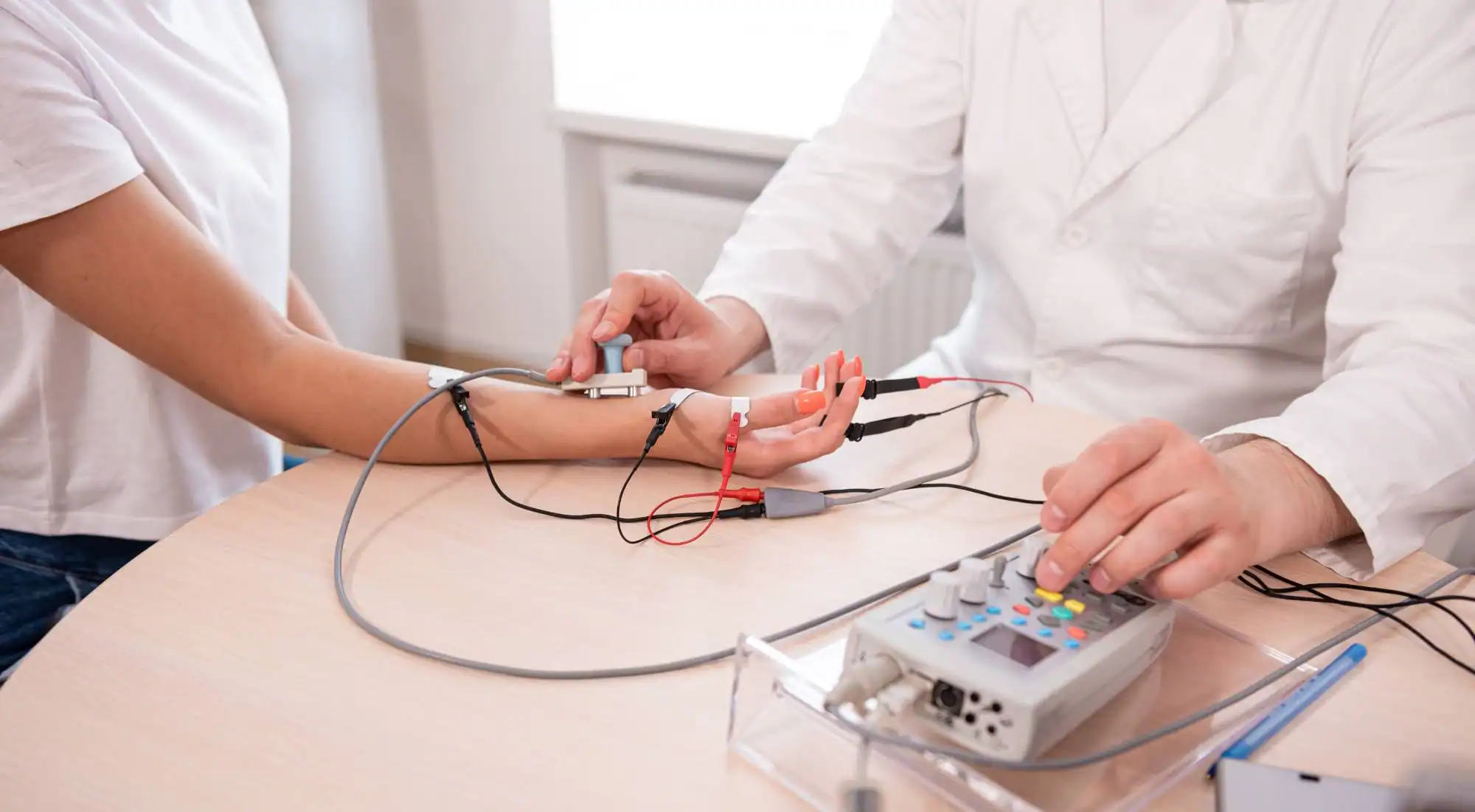
That is the gap electromyography and nerve conduction testing were built to close. Together they measure whether your nerves are conducting signals normally, and whether the muscles those nerves supply are receiving the instructions they should. The result is objective data about function, in a situation where everything else is either a description or a picture.
What follows is less about what the test feels like and more about why your physician wants it, and what the answer will actually change.
Why Nerve Problems Are Hard To Diagnose From Symptoms Alone
Nerve symptoms are notoriously misleading about their own origin.
Numbness in the hand can come from the wrist, the elbow, the shoulder region, or the neck. Weakness in the foot can come from a nerve root in the low back, from the nerve as it wraps around the outside of the knee, or from the muscle itself. Burning in both feet can be a peripheral neuropathy, or it can be spinal stenosis, and the treatments for those two are not remotely the same.
A careful physical examination narrows this considerably. Reflexes, strength testing, and sensory mapping all carry real information. But examination findings can be subtle, symptoms fluctuate from day to day, and patients often have more than one thing going on at once, which is exactly the situation where clinical reasoning alone starts to run out of room.
Testing is what turns a reasonable suspicion into a documented finding.
What Question Is Your Doctor Trying To Answer?
An EMG referral is rarely a general request to look around. There is almost always a specific question behind it, and knowing which one helps you understand the result you get back.
Is there real nerve damage, or are these symptoms coming from something else? Plenty of hand tingling turns out to be positional, and plenty of leg pain is muscular. Objective testing separates the two.
Where along the nerve is the problem? This is often the main reason the test is ordered. A nerve can be compressed at several points along its journey, and the treatment depends entirely on which point.
How severe is it? There is a large difference between a nerve that is slowed but intact and one that has lost fibers. That distinction affects urgency, and it affects the choice between continuing conservative treatment and doing something more definitive.
How long has this been going on? Testing can distinguish changes that look recent from changes that look chronic, which matters when someone has had symptoms on and off for years and a new injury is in question.
Is this one nerve or many? A single trapped nerve is a local problem. A pattern affecting many nerves in both feet or both hands points toward a systemic cause, such as diabetes, thyroid disease, a vitamin deficiency, or a medication effect, and that changes the workup entirely.
Different questions call for different testing, which is why the study is tailored on the day rather than run as a fixed protocol.
Ruling Things Out Matters As Much As Ruling Things In
Patients tend to think of tests as looking for a problem. In nerve testing, a normal result is often the most useful thing that can happen.
Consider someone with an MRI showing a disc bulge and pain running down one leg. Disc bulges are extremely common and frequently silent. If nerve testing shows no evidence that the corresponding nerve root is affected, that finding argues against operating on the disc and pushes the search toward the hip, the sacroiliac joint, or a vascular cause. That is a decision worth having good information about.
Or consider hand numbness that everyone has assumed is carpal tunnel syndrome. If the study shows normal conduction across the wrist, the assumption is wrong, and wrist surgery would not have helped. The real source might be the neck, the elbow, or a more generalized neuropathy.
Testing also helps separate a nerve problem from a muscle problem, and both of those from a joint or tendon problem that produces apparent weakness simply because pushing hurts. Those situations look similar from the outside and are treated in completely different ways.
It is also why a physician may order the test even when they are fairly confident already. Fairly confident is a reasonable basis for starting physical therapy. It is a thin basis for surgery.
The practical value is straightforward. A confirmed diagnosis tells you what to do. A confidently excluded diagnosis stops you doing something that was never going to work, which in this field is usually the more expensive mistake.
Want live answers?
Connect with a NY Spine Medicine expert for fast, friendly support.
Where EMG Fits Alongside MRI, Bloodwork, And Examination
These tests are not competitors, and no single one of them settles most cases.
An MRI shows structure in extraordinary detail. It will find the narrowed opening, the herniation, the fracture. What it cannot tell you is whether any of that is affecting nerve function today, which is why imaging findings and symptoms so often disagree with each other.
Bloodwork explains why a nerve problem exists when the pattern suggests a systemic cause. Glucose, thyroid function, vitamin B12, and kidney function all matter when many nerves are involved.
Nerve testing supplies the functional layer. It confirms whether the structure on the scan is actually causing trouble, and it points the bloodwork in the right direction by showing the pattern of involvement. Read together, the three usually converge on one explanation.
How Testing Separates A Neck Problem From A Wrist Problem
This is the clearest illustration of what nerve testing does, so it is worth walking through slowly.
Say your thumb, index finger, and middle finger go numb at night. Carpal tunnel syndrome is the obvious suspect, and often it is the answer. But those same fingers are served by nerve fibers that originate at the sixth and seventh cervical nerve roots in your neck, and a compressed root there can produce a very similar sensation.
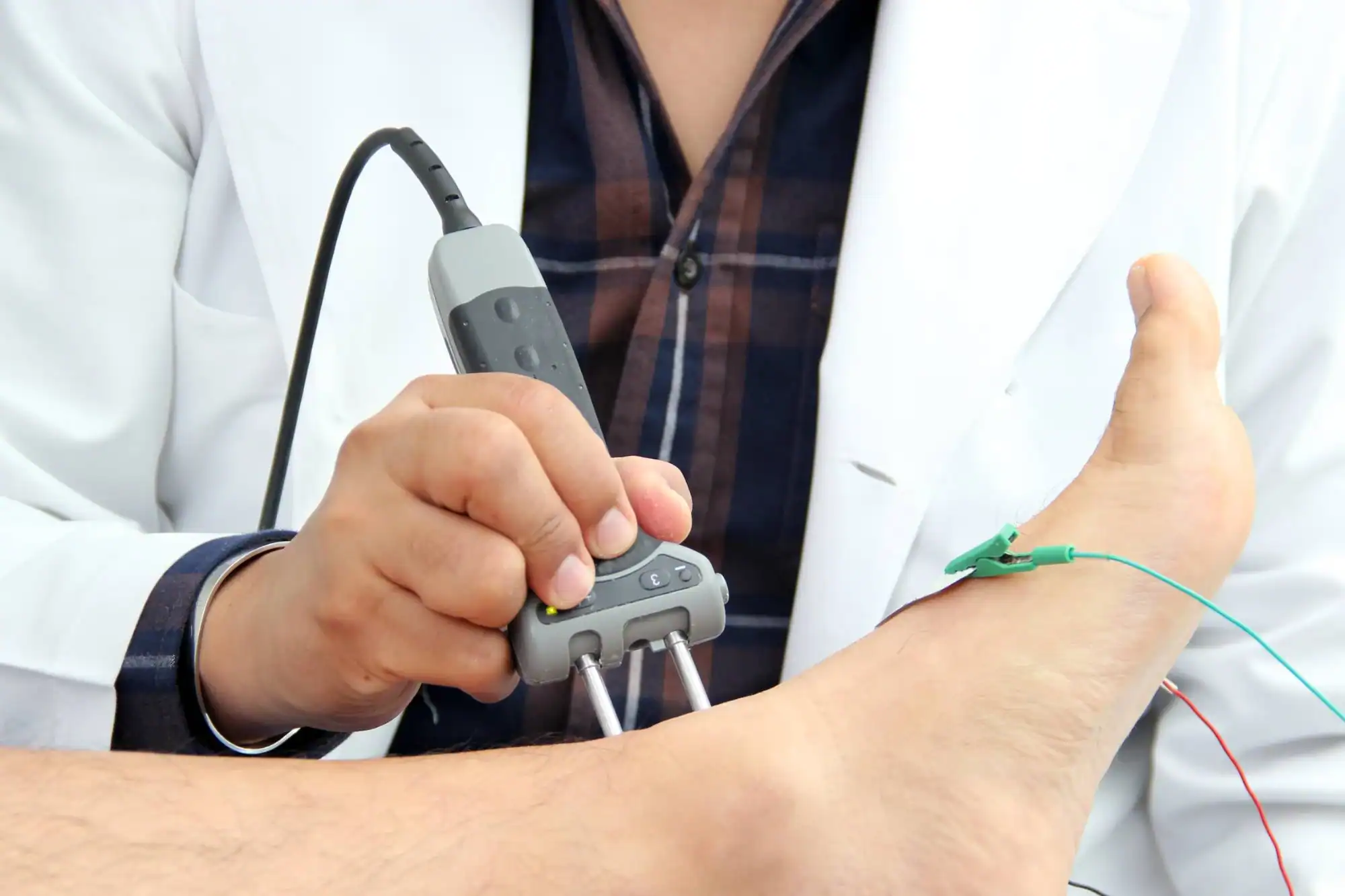
The nerve conduction study stimulates the nerve at several points along its course and measures how the signal behaves between them. If the signal slows specifically as it crosses the wrist and is normal everywhere above that, the problem is at the wrist. If conduction across the wrist is normal, the wrist is not the culprit no matter how much it feels like it should be.
The needle portion then examines muscles supplied by different nerve roots. If muscles that share a nerve root but are supplied by different peripheral nerves all show changes, that points to the root rather than to any single nerve. If the changes are confined to muscles beyond the wrist, the wrist is confirmed.
The same logic applies elsewhere. Foot drop can come from the fifth lumbar nerve root or from the peroneal nerve at the outside of the knee, and testing distinguishes them the same way. Numbness in the small fingers can come from the elbow or from the neck.
It is also entirely possible to have two problems at once, and the study can show that too. That happens often enough that assuming a single cause is a common way to end up with a treatment that only partly works.
Why Timing Affects Accuracy, And When Testing Too Early Misleads
Nerve testing is very good at what it measures, but it is measuring changes that take time to appear.
After an acute nerve injury, the nerve conduction portion can show abnormalities fairly quickly. The muscle portion is slower. The electrical changes that show up in a muscle after it loses its nerve supply typically take a couple of weeks to develop. A study performed a few days after an injury can therefore look reassuring when the injury is entirely real.
This is why a physician may examine you, hear a convincing story, and still schedule the test several weeks out. It is not delay for its own sake. It is a deliberate choice to test at a point when the result will mean something.
Timing works in the other direction as well. In a much older injury, the muscle may have partially reinnervated itself, and the findings shift from looking acute to looking chronic. An experienced electromyographer reads those patterns and can often say roughly how old a process appears to be, which matters a great deal in work injury and auto accident cases where the timeline is contested.
There are limits worth knowing about. The very small nerve fibers responsible for burning pain and temperature sensation in some neuropathies are not well captured by standard testing, so a normal study does not always mean there is no neuropathy at all. Results can also be affected by cold limbs and by significant swelling, which is why the technologist warms your hands and takes the measurements carefully.
And urgency overrides scheduling. Rapidly progressive weakness, weakness in both legs, loss of bowel or bladder control, numbness in the groin area, or symptoms that began after significant trauma need immediate evaluation rather than a test appointment three weeks from now.
Getting Clear Answers About Nerve Symptoms In New York City
The real takeaway is that EMG and nerve conduction testing is not a formality on the way to treatment. It is often the step that determines what the treatment should be, and occasionally the step that prevents an unnecessary one.
A more useful frame: imaging tells you what your anatomy looks like, and nerve testing tells you what your anatomy is doing. When those two disagree, and they frequently do, the functional answer usually deserves more weight in deciding what happens next.
At NY Spine Medicine, our physicians in Manhattan and Brooklyn perform this testing inside the same practice that manages the treatment, so the results are interpreted by the people who will also be discussing your options with you. Nothing gets faxed into a void, and the plan is built from the findings rather than around them.
If you have numbness, tingling, or weakness that nobody has been able to explain, call us at 212-750-1155 and we will work out what is actually going on.